 blog
Are Martial Arts Safe for Older Adults?
Last Updated: November 17, 2026
Quick Summary
Martial arts for older adults can be a low-risk way to build strength, balance and confidence when training is structured, progressive and taught by an experienced instructor. Form-based, non-contact styles are generally the safest starting point, and a doctor should be consulted first if you have heart, balance or joint conditions.
- Sessions of 60 to 90 minutes, at least twice a week, are recommended for older practitioners.
- Functional benefits generally appear over about 11 weeks of consistent practice.
- Tai chi and traditional karate forms are the lowest-risk entry point for adults with balance concerns or joint pain.
- Talk to your doctor before starting, especially with heart, balance or joint conditions.
- Ask about free trials, contracts and fees in writing before enrolling.
Table of Contents
- Why Martial Arts for Older Adults Is Worth Considering
- Balance, Flexibility and Strength Gains in the Research
- Best Martial Arts for Older Adults: Styles Compared
- Choosing the Right Style for Physical Limitations
- Beginner Martial Arts for Older Adults: What a First Class Looks Like
- Training Safely: Medical Screening, Costs and Commitment
- Finding Martial Arts for Older Adults Near Me in Alexandria, Virginia
- Frequently Asked Questions
Why Martial Arts for Older Adults Is Worth Considering
Martial arts for older adults is a practical way to build strength, balance and confidence at any age past 50. At Virginia Dojo in Alexandria, our adult program is built around natural movement and real-world self-defense rather than brute force, with no contracts.
The question most people ask is whether it is safe. Training that is structured, progressive and taught by an experienced instructor can be a low-risk way to stay active. one guidance document from the National Institutes of Health recommends sessions of 60 to 90 minutes, at least twice a week, for older practitioners (PMC guidance on hard martial arts training for older adults).
Many adults in their 50s and 60s come to martial arts after years away from physical activity. They worry about keeping up or feeling out of place. A good beginner class solves that by setting the pace around the individual student, not around the fastest person in the room. Our Adult Self Defense Karate program is designed with exactly that approach, so new students can start where they are.
Balance, Flexibility and Strength Gains in the Research
Studies of martial arts for older adults point to measurable gains. A report from Florence Martial Arts (2026) cites strength improvements ranging from 9.3% to 34%, mobility gains of 9.5% to 13.6%, and balance improvements of roughly 20.5%. These figures come from a practitioner source, so treat them as directional rather than definitive.
A Springer study (2022) found that five weeks of Yuishinkai karate training significantly improved balance and neuromuscular function in older adults.
Minimum durations matter too. The same NIH-hosted guidance notes that functional benefits generally appear over about 11 weeks of consistent practice.
Some research is more cautious. A ScienceDirect study (2025) found that standard exercises can be more effective than martial arts for improving handgrip strength specifically. Martial arts is a strong all-round option, not a replacement for every form of strength training.
Best Martial Arts for Older Adults: Styles Compared
Three broad categories cover almost every option:
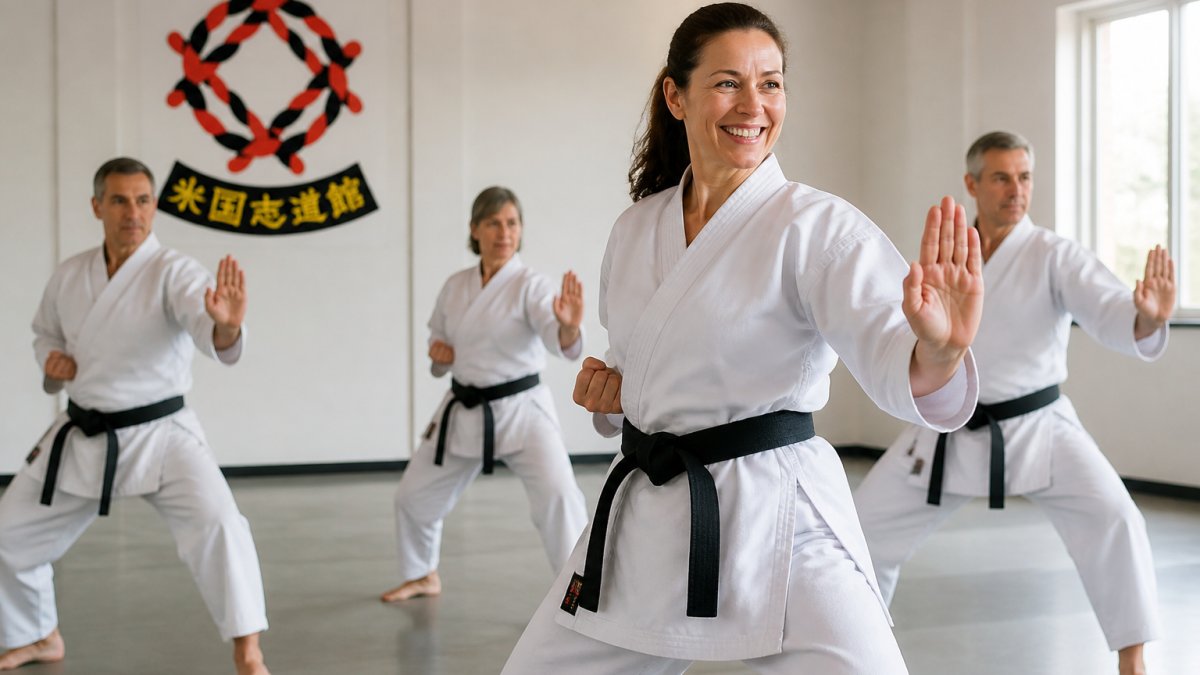
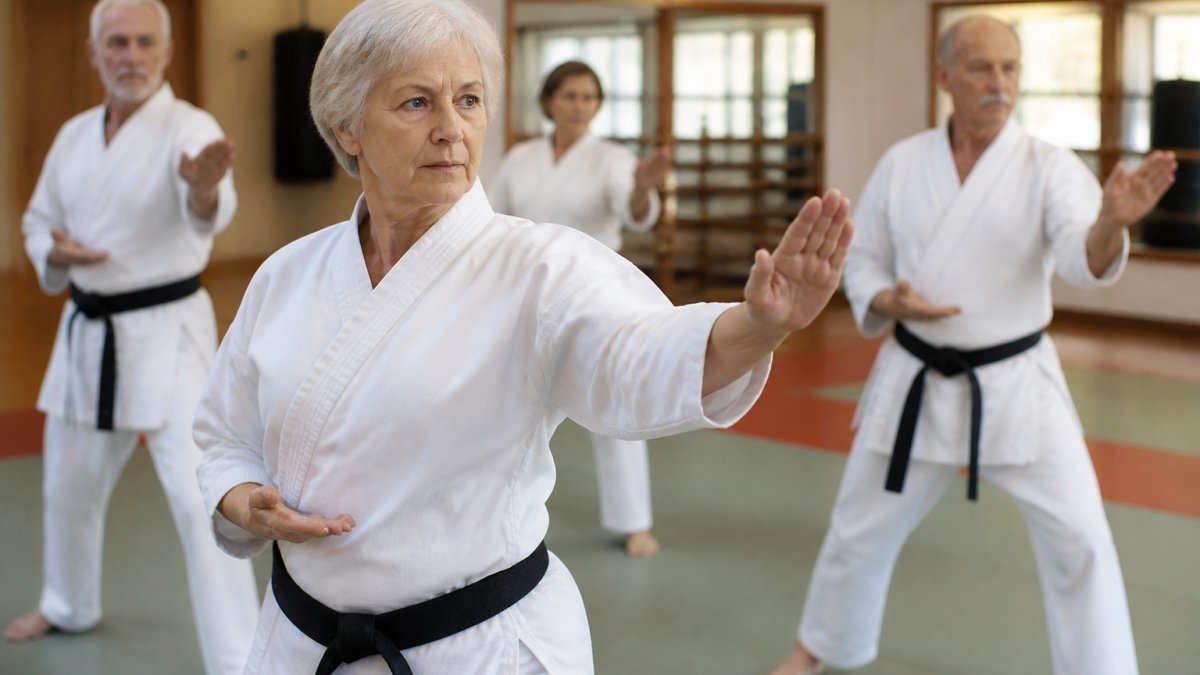
- Non-contact, form-based training. Tai chi and traditional karate kata (forms) are practiced solo or in lines, with no partner contact. The demand is on stance, weight shift, posture, and controlled movement. This is the lowest-risk entry point for adults with balance concerns or joint pain, and it is where most beginners over 50 start.
- Light-contact partner drills. Some schools pair students for controlled, pre-arranged self-defense drills with padded targets or light touch. The demand is coordination and trust in a partner, not impact. Ask specifically how contact is controlled and whether drills are optional.
- **
At Virginia Dojo we teach Okinawan Shorin Ryu Karate, a traditional form-based style with a self-defense focus. Training is built around natural movement, stance work, and technique rather than impact, which is why we point beginners in their 50s and 60s toward it. The style you choose should follow from your goals: balance and joint-friendly movement point to form-based training; practical self-defense points to a style that teaches technique application; general fitness can be met by almost any style practiced consistently.
Comparison Table: Contact Level and Demand by Style
Style | Contact level | Primary demand | Best for |
|---|---|---|---|
Shorin Ryu karate | None in beginner training | Stance, footwork, forms, self-defense technique | Practical self-defense with fitness |
Best for: adults who want a balanced mix of fitness and practical defense through form-based training. Skip if: you have a recent joint injury or cannot get up and down from the floor, since grappling styles will be harder to adapt.
Watch out: a school that cannot tell you plainly how contact is controlled in beginner classes is a school to visit before you enroll, not one to sign with on the phone.
Choosing the Right Style for Physical Limitations
Start with an honest look at your joints, balance and any medical history. Knee or hip problems usually rule out high-impact striking and heavy floor work. Balance concerns point toward stance-based and tai chi-style training, which work on weight shift and controlled movement.
Ask the instructor how a class adapts for different bodies. A good program lets students choose their intensity, sit out a drill and progress at their own pace. If an instructor pushes everyone to the same level, look elsewhere.
We recommend talking to your doctor before starting, especially if you have heart, balance or joint conditions. Bring a list of the movements you plan to practice.
Beginner Martial Arts for Older Adults: What a First Class Looks Like
A first class usually starts with a warm-up of gentle movement and breathing, then basic stances and simple techniques taught one step at a time. You will not be asked to perform advanced forms on day one. Expect to be shown each movement, practice it slowly, and be corrected without embarrassment.
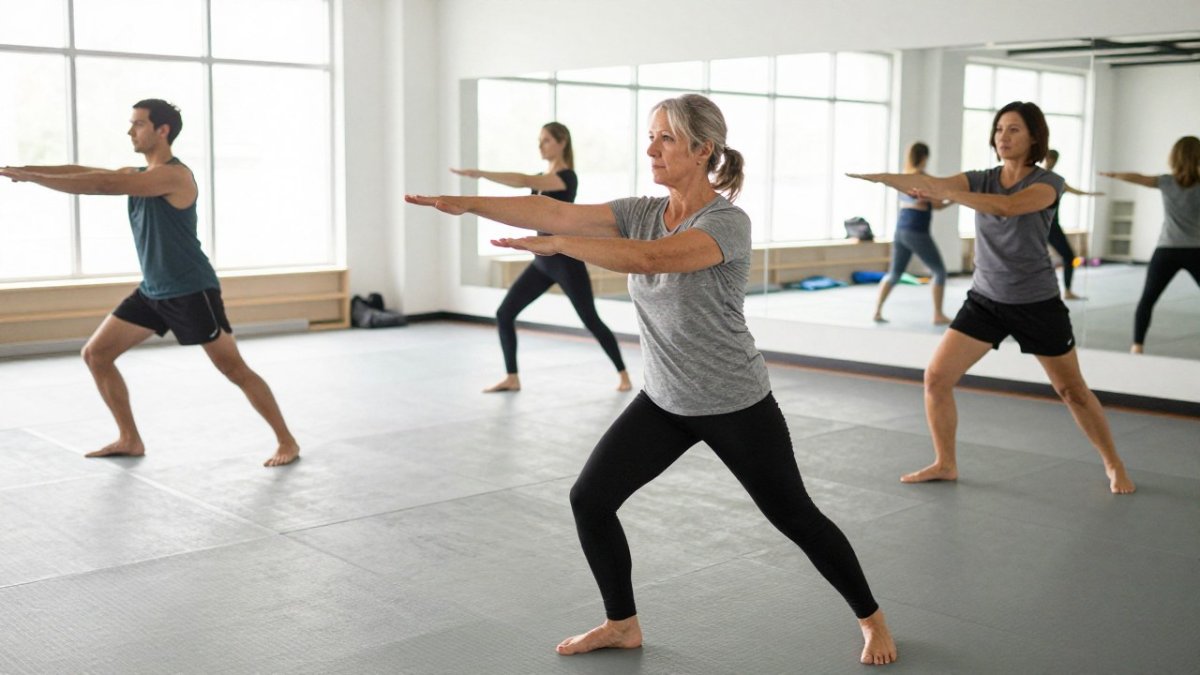
Many new students are surprised by how much of the class is about control rather than speed. Sessions end with stretching, which helps with the flexibility goals many adults bring to the mat.
Bring comfortable clothing. At Virginia Dojo, students receive a free karate uniform, so you do not need to buy gear to start.
Training Safely: Medical Screening, Costs and Commitment
Safety in martial arts for older adults comes from three things: screening before you start, disclosure to your instructor, and gradual progression once you are on the mat. Most guides skip the practical steps, so here is what to actually do.
Before your first class. If you have a heart condition, uncontrolled blood pressure, diabetes, osteoporosis, a balance disorder, or a recent joint injury or surgery, talk to your doctor before starting. Ask specifically whether stance work, weight shifting, and getting down to and up from the floor are appropriate for you. Bring a short list of the movements you plan to practice so the conversation is concrete. If you take medication that affects balance or blood pressure, mention it.
Telling your instructor. A good instructor wants to know about old injuries, surgeries, and limitations before you step on the mat, not after something hurts. Tell them which joints are sensitive, whether you have fallen in the past year, and whether floor work is difficult. Ask how drills are adapted when a student cannot perform a movement, the answer should be a modification, not a suggestion to push through.
Progressing gradually. Expect to start with stance and basic technique and to add intensity over weeks, not days. Soreness in muscles is normal; sharp pain, joint swelling, or dizziness is not. Stop any movement that causes sharp pain and tell your instructor.
Costs and commitment. Ask four questions before you enroll: Is there a free trial or observation class? What does enrollment cost, and is there a uniform or equipment fee? Are there long-term contracts or cancellation fees? What is the monthly rate, and does it change by program? At Virginia Dojo, a free trial is offered, there are no contracts, and students receive a free karate uniform. Pricing depends on the program, so contact us or visit our website for current rates.
Accessibility and logistics. Confirm parking, public transit access, and whether the facility has a changing area and seating for a companion who wants to observe. Ask about class times, a mid-day class is easier for many older adults than an evening session, and whether you can observe a full class before participating.
Watch out: a school that will not put its trial terms, contract length, and fees in writing before you enroll is telling you something about how it handles the rest of the relationship.
Finding Martial Arts for Older Adults Near Me in Alexandria, Virginia
If you are searching for martial arts for older adults near me in Alexandria, Virginia, the practical next step is to visit a class in person. Ask to observe a session, meet the instructor and see how students of different ages train together. Our Mid-Day Dojo Class is designed for seniors, and our Adult Self Defense Karate program suits students looking for real-world skills.
Start with a free trial to see whether the environment feels right. The best program is one you will attend consistently, and that is the real test of whether martial arts works for you.
Visit book a trial class or read more about self defense karate for seniors to find the right fit. For a deeper look at the research, see how martial arts improve balance and flexibility after 50. If safety is your main concern, our injury prevention rules for adult martial arts cover what to check before you start, and if you want to avoid long commitments, see karate classes without long-term contracts. Local readers can also review self defense karate for women in Alexandria.
Get started with Virginia Dojo and build balance, flexibility and confidence at your own pace.
Frequently Asked Questions
What martial art is best for older adults?
There is no single best choice, but styles built around controlled, low-impact movement are the usual starting point for adults over 50. Tai chi and Okinawan karate emphasize stance work, balance and natural movement rather than strength or hard contact. The best fit depends on your joints and your goals, so try a trial session before committing.
Can a 60-year-old start martial arts for the first time?
Yes. Many adults start martial arts in their 50s, 60s and beyond, and beginner classes are designed around new students. Tell the instructor about any injuries or conditions on day one so the class can be adapted to you.
Should older adults talk to a doctor before starting martial arts?
Speaking with a doctor before starting is a sensible step, especially if you have heart disease, joint problems, balance issues or recent surgery. A doctor can tell you which movements to avoid and how hard to train. Share that guidance with your instructor so your practice can be modified for your body.
Can martial arts help older adults improve balance and flexibility?
Results vary by person and program, and consistent weekly practice matters more than any single session. Virginia Dojo offers a free trial if you want to see how the training feels before deciding.