 blog
blog
Low Impact Fitness Classes in Alexandria VA: 2026 Guide
Table of Contents
- What Counts as a Low Impact Fitness Class in Alexandria, VA
- Low-Impact Exercise for Beginners: What to Expect in Your First Month
- Beginner Fitness Classes in Alexandria VA: Yoga, Pilates, and Martial Arts
- Fitness Classes for Balance and Flexibility in Alexandria VA
- Group Fitness Classes in Alexandria VA: Intensity, Duration, and Format Compared
- How to Choose the Right Low Impact Fitness Class for You
- Conclusion: Start Your Low Impact Fitness Routine in Alexandria
- Frequently Asked Questions
Last Updated: October 9, 2026
What Counts as a Low Impact Fitness Class in Alexandria, VA
Low impact fitness is any workout that raises your heart rate and builds strength without the repeated pounding of jumps, hops, or hard landings.
If you have searched for low impact fitness classes in Alexandria VA, you already know the problem: most studio listings blur together. A "gentle" class turns out to be a fast-paced circuit; a "beginner" class assumes you can already touch your toes.
Low Impact vs. High Impact: What Your Joints Feel
Low impact exercise is movement where at least one foot stays in contact with the ground, so your joints absorb far less landing force. Walking, swimming, cycling, yoga, Pilates, and most martial arts drills all qualify.
The CDC physical activity guidelines for adults recommend at least 150 minutes of moderate-intensity aerobic activity each week, plus two days of muscle-strengthening work. Nothing in those guidelines requires jumping.
Who Gets the Most From Low Impact Training
Adults over 50, people returning after an injury, and anyone carrying extra weight tend to see the biggest gains from low impact work. The reason is simple: you can train more often when you are not sore for two days afterward. Consistency beats intensity every time, and low impact formats make consistency realistic.
Low-Impact Exercise for Beginners: What to Expect in Your First Month
Your first month is about showing up, not pushing limits. Expect to learn the movements, feel mildly sore after the first two or three sessions, and notice better sleep and steadier energy within a few weeks. A common mistake is going too hard in week one: start at roughly 60 percent of what you think you can handle, then add a little each week.
Here is a realistic four-week ramp:
Week | Focus | Sessions Per Week | What You Should Notice |
|---|---|---|---|
1 | Learn the movements slowly | 2 | Mild soreness, better sleep |
2 | Add repetitions, keep the pace easy | 2-3 | Easier breathing, less stiffness |
3 | Hold positions longer | 3 | Steadier balance on one leg |
4 | Add light resistance or deeper stances | 3 | Noticeable strength and stamina gains |
What a Typical First Class Actually Looks Like
Most low impact classes in Alexandria run 45 to 60 minutes and follow a predictable arc: a warm-up that raises your heart rate without pounding, a main block of controlled strength or mobility work, and a cool-down with stretching. In a martial arts class, that main block is usually stances, stepping drills, and slow forms practice; in mat Pilates, floor core work; in gentle yoga, held postures linked to breath.
Modifications You Can Ask For
Low impact does not mean one-size-fits-all. Most instructors can offer a seated or chair-supported version of standing work, a smaller range of motion for stiff shoulders, and a narrower stance for hip or knee sensitivity. If you have a specific limitation, say so before class starts; good instructors treat that as useful information, not an inconvenience.
What to Bring and Wear
- Most indoor martial art practice is with bare feet.
- A water bottle and a small towel
- Loose clothing you can move and breathe in
How to Tell It Is Working
Progress in low impact training shows up in unglamorous ways: you can hold a single-leg stance longer, get off the floor without using your hands, take the stairs without pausing. Track one or two of those markers instead of chasing soreness. If you can train twice a week for a month without dreading the next session, you have built the habit that matters more than any single workout.
Beginner Fitness Classes in Alexandria VA: Yoga, Pilates, and Martial Arts
Three formats dominate beginner fitness classes in Alexandria VA: yoga, Pilates, and martial arts. Each builds strength and mobility without pounding your joints.
Yoga and Pilates for Core and Mobility
Yoga and Pilates are the two most accessible entry points into low impact training. Yoga links breath with slow, held postures to build flexibility and balance.
Look for all-levels classes rather than "advanced" sessions. A good instructor offers modifications for every pose, so a 58-year-old with stiff hips and a 30-year-old runner can both get what they need from the same hour.
Martial Arts as Low Impact Training
Traditional martial arts can be one of the most complete low impact workouts available, when the school trains for practical skill rather than hard contact. Okinawan karate, for example, emphasizes natural movement, stances, and body mechanics over brute strength. Maintaining these precise, fluid motions requires a stable foundation provided by supportive workout gear that protects your joints during repetitive practice.
At Virginia Dojo, our adult program is built around Okinawan Shorin Ryu Shi-Do Kan Karate, taught by a 9th-degree master with over 50 years of experience. Students work on balance, flexibility, and practical self-defense at their own pace. You can read more about our National Institute on Aging exercise and physical activity guidance for how balance and strength training support healthy aging.
Fitness Classes for Balance and Flexibility in Alexandria VA
Balance and flexibility are the two qualities adults lose fastest with age, and the two that most fitness classes ignore.
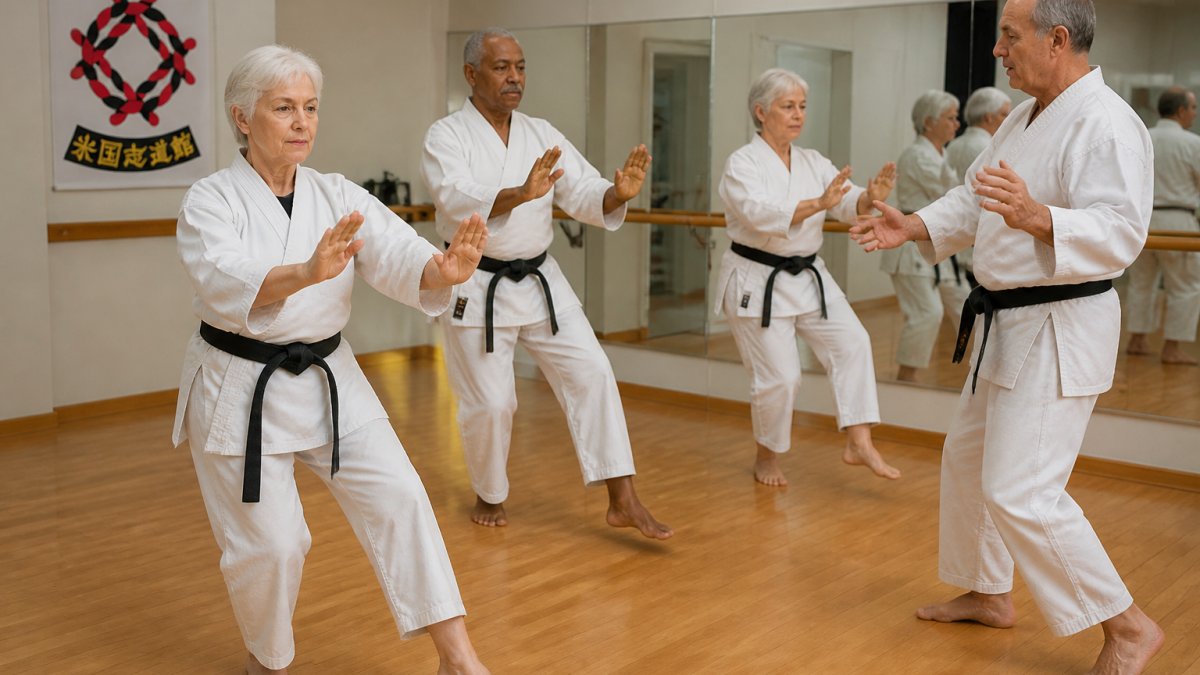
Adults in their 50s and 60s practicing slow, controlled balance movements in a bright martial arts studio with padded floors and mirrored walls, instructor guiding from the side
Why Balance Declines, and How Training Reverses It
Balance depends on three systems working together: your inner ear, your vision, and the pressure sensors in your feet and ankles. All three send signals to your brain, which tells your muscles how to correct. When you stop challenging that loop, it gets slower and less precise. Standing on one leg, shifting weight slowly from foot to foot, and turning your body under control all force the loop to work.
Start Now Before Someone Nabs Your Spot in Class! →
A Simple Progression You Can Do Anywhere
- Week 1-2: Hold a single-leg stance for 20 seconds near a wall or counter for support.
- Week 3-4: Extend the hold to 30 seconds and add a slow head turn while balancing.
- Week 5-6: Add a gentle forward reach or a slow torso twist during the hold.
- Week 7+: Progress to eyes-closed holds or standing on a folded towel for a softer surface.
Do this on both sides, and stop if you feel unsteady enough that you would need to grab something.
How Martial Arts Training Builds Both
Martial arts training builds balance almost as a side effect. Holding a stance, shifting weight between feet, and turning the body under control all demand the same stabilizing muscles you use to catch yourself on an uneven sidewalk. For older adults who want strength and confidence without hard landings, this combination of balance work and practical self-defense is hard to match.
Accessibility and Logistics in Alexandria
Before you commit to a class, confirm a few practical details. Ask whether the studio has a ground-floor entrance or an elevator, whether there is a place to sit and rest between drill. Parking and transit matter too: Old Town and the neighborhoods around it have metered street parking and limited lots, while studios farther from the waterfront often have their own parking.
Group Fitness Classes in Alexandria VA: Intensity, Duration, and Format Compared
Group fitness classes in Alexandria VA range from gentle restorative sessions to vigorous cardio, and the format you choose matters more than the brand name on the door. Compare typical intensity, duration, and joint demand before you commit.
Class Format | Typical Intensity | Session Length | Joint Impact | Best For |
|---|---|---|---|---|
Gentle or restorative yoga | Low | 60 min | Very low | Stress relief, mobility |
Pilates mat work | Low to moderate | 45-60 min | Very low | Core strength, back support |
Traditional karate (no contact) | Moderate | 60 min | Low | Balance, self-defense, full-body strength |
Water aerobics | Moderate | 45 min | None | Joint pain, recovery |
Low impact cardio or step | Moderate | 45-60 min | Low | Heart health, stamina |
Dance fitness, slower tempo | Moderate | 45-60 min | Low to moderate | Fun, coordination, cardio |
Duration is the variable people underestimate. A 45-minute class you attend three times a week beats a 90-minute class you attend once. Frequency drives adaptation.
If a class leaves you limping the next day, that is not a sign of a good workout. Persistent joint pain after a session usually means the impact level is too high for your current condition, and pushing through it is how small problems become injuries.
How to Choose the Right Low Impact Fitness Class for You
Choose the class you will actually attend twice a week, at a time that fits your life, with an instructor who offers modifications. Everything else is secondary. Start by deciding your goal: yoga for flexibility and calm, Pilates for core strength and back support, or a traditional martial arts program for balance, practical self-defense, and full-body conditioning in one package.
Questions to Ask Before You Enroll
Ask these before you sign anything:
- Does the instructor offer modifications for stiff hips, bad knees, or limited shoulder range?
- Is there any contact required, or is training done at your own pace?
- What is the cancellation or contract policy if my schedule changes?
If a school dodges the contract question or pressures you to commit on the first visit, that tells you everything.
If you are searching for "low impact fitness near me" in Alexandria, try one class at two or three different studios and compare how your body feels the next morning. That single test tells you more than any brochure.
Conclusion: Start Your Low Impact Fitness Routine in Alexandria
Finding a routine you can sustain for years is harder than finding a workout that hurts. The adults who stick with training chose a format that respects their joints, a schedule that fits their week, and a community that welcomes them at any fitness level.
At Virginia Dojo, we teach Okinawan Shorin Ryu Shi-Do Kan Karate to adults and mature teens in a supportive, non-competitive setting.
Frequently Asked Questions
What counts as a low-impact fitness class?
A low-impact fitness class keeps at least one foot on the ground during most movements, so your joints absorb far less repeated force than running or jumping. Yoga, Pilates, water aerobics, and traditional martial arts forms all qualify. The workout still raises your heart rate and builds strength; it just does it through controlled, grounded movement. If you have knee, hip, or back concerns, low impact formats let you train consistently without the soreness that stops high-impact routines.
Are low-impact workouts suitable for beginners?
Yes. Low-impact exercise for beginners is often the smartest starting point because the movements are easier to learn and less likely to cause injury while your body adapts. Start with two or three sessions per week, keep each one to 30-45 minutes, and add time gradually. Look for classes labeled all-levels or beginner-friendly, and tell the instructor it is your first class so they can offer modifications for any movement that feels awkward.
Can low-impact exercise help improve balance and flexibility?
Balance and flexibility respond well to consistent low-impact training. Yoga and Pilates build flexibility through controlled stretching and core work. Martial arts stances train your ankles, knees, and hips to stabilize your body in motion, which carries over to everyday tasks like stepping off a curb or catching yourself on uneven pavement. Two sessions a week for eight to twelve weeks is a reasonable timeframe to notice steadier footing and easier reaching.
What should I ask an instructor before joining a class?
Ask three things: what a typical class format looks like, how the instructor handles modifications for stiff joints or old injuries, and whether you can try a class before committing to a membership. Also ask about class size and whether the instructor holds a recognized certification. A good instructor welcomes these questions and will describe exactly how they adjust movements for different fitness levels rather than giving a vague answer.