 how-to
Is Karate Good for Balance and Flexibility?
Table of Contents
- Is Karate Good for Balance and Flexibility? What Adults Should Expect
- Karate for Balance and Coordination: How the Training Builds Both
- Karate for Flexibility: Which Parts of the Body Improve and How
- Karate Warm-Up Stretches for Adults (Before Every Class)
- How Often Should Adults Practice Karate to See Balance and Flexibility Gains?
- Starting Karate in Alexandria When You Feel Stiff or Unsteady
- Conclusion: Balance and Flexibility Are Trainable at Any Age
- Frequently Asked Questions
Last Updated: October 12, 2026
Is Karate Good for Balance and Flexibility? What Adults Should Expect
Yes. If you are wondering is karate good for balance and flexibility, karate is one of the better training systems for both because it trains them every single class, without lifting heavy weight or taking hard impacts. At Virginia Dojo in Alexandria, Virginia, we teach Okinawan Shorin Ryu Shi-Do Kan karate to adults and mature teens, and the question we hear most is simple: will this actually help me move better?
The answer is yes, and it shows up fast. Karate asks you to stand on one leg, shift your weight slowly, and reach through a full range of motion. That repeated practice is what rebuilds steadiness and looseness. Below, we break down which movements do the work, how often to practice, and how to start when you feel stiff or unsteady.
Karate for Balance and Coordination: How the Training Builds Both
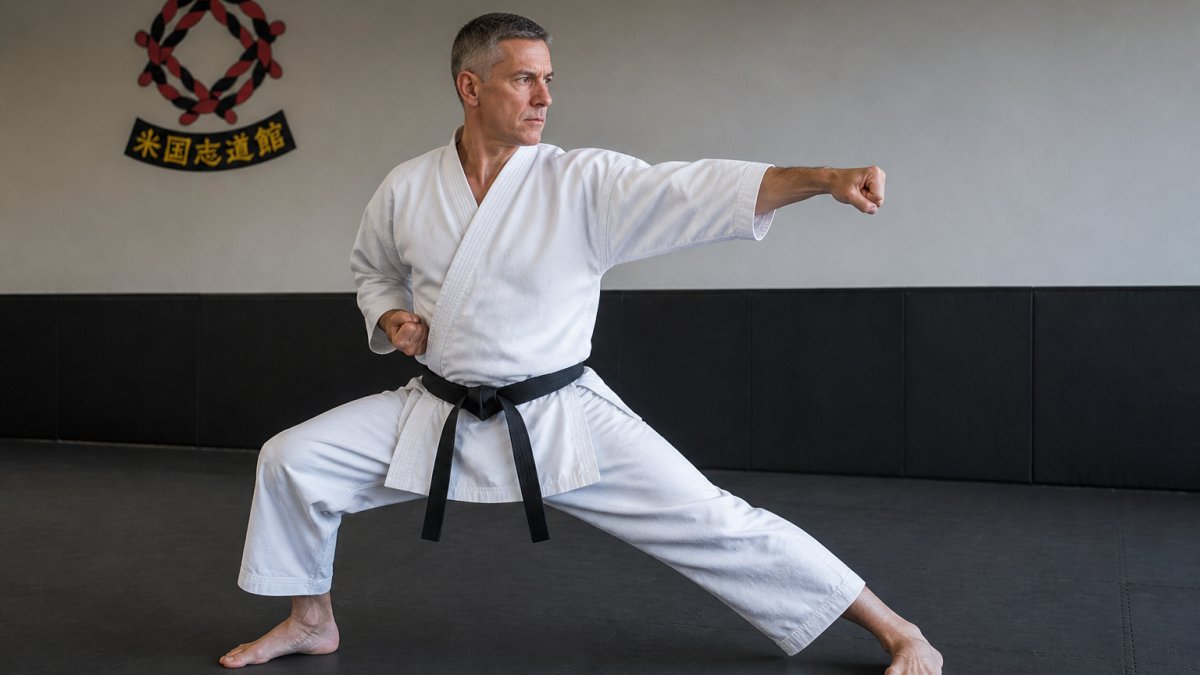
Balance improves in karate because every stance forces your body to steady itself against gravity, and coordination improves because your arms and legs learn to move as one unit. A front stance, a cat stance, a turn: each one asks your muscles to make tiny corrections, hundreds of times per class.
Those corrections are the training. Your ankles, knees, and hips learn to react before you think about it. Over weeks, that reaction time gets faster and steadier.
Karate for balance and coordination works on three skills at once:
- Static balance: holding still in a stance without wobbling
- Dynamic balance: staying steady while stepping, turning, or shifting weight
- Coordination: moving hands, feet, hips, and breath together
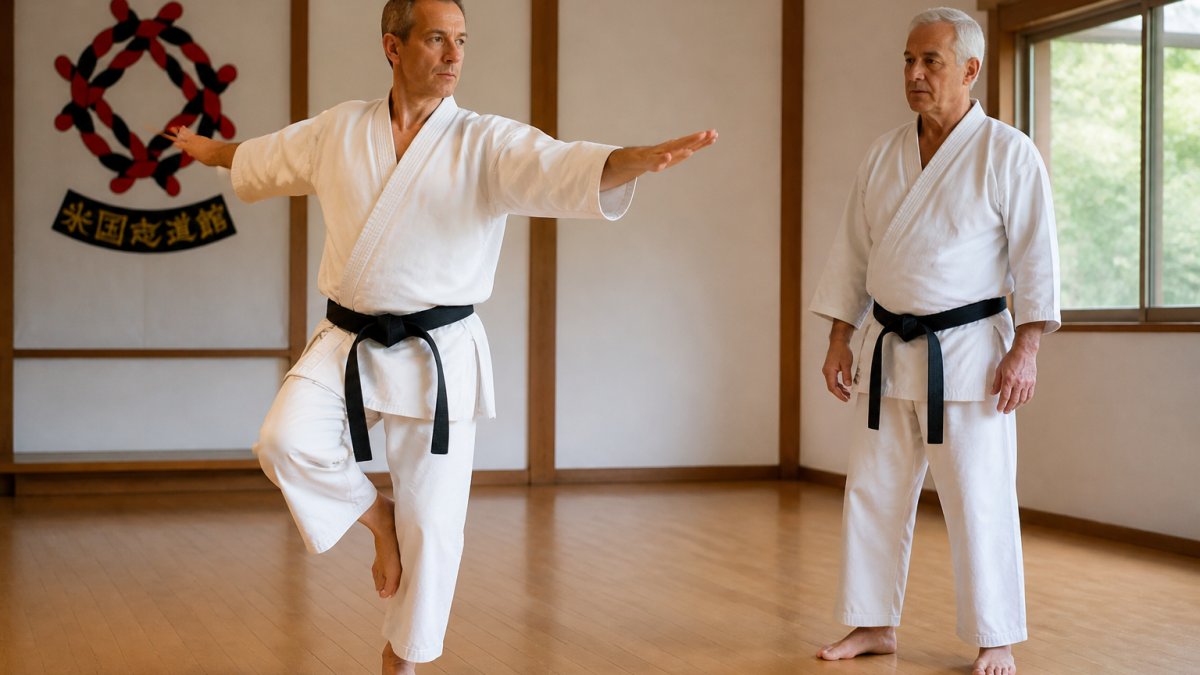
Which Karate Movements Train Balance Most
The movements that train balance best are the slow ones. Fast movement hides wobble; slow movement exposes it and fixes it.
- Single-leg stances: standing on one foot while the other lifts or extends
- Weight shifts: moving from one leg to the other without rushing
- Slow turns: pivoting while keeping your center steady
- Kata: a set sequence of stances, turns, and strikes performed alone
- Kicks held in the air: extending a leg and controlling it on the way back down
A common mistake is rushing these. Speed feels impressive, but slow control is what builds steadiness.
Karate for Flexibility: Which Parts of the Body Improve and How
Karate for flexibility targets the hips, hamstrings, shoulders, and ankles, because those are the joints that stances and kicks demand most. You do not need to already be flexible to start. The training builds the range you need, one class at a time.
Here is where adults usually see the biggest change:
- Hips: open up from stances and slow kicks
- Hamstrings: lengthen from forward stances and leg extensions
- Shoulders: loosen from repeated punches and blocks
- Ankles: gain range from rising onto the ball of the foot
The key is consistency, not intensity. Short, regular stretching beats one long session per week. Your body adapts to what you ask of it often.
Karate Warm-Up Stretches for Adults (Before Every Class)
Karate warm-up stretches for adults should take a few minutes and move from gentle to more active. The goal is to wake up the joints and raise your body temperature, not to force a deep stretch while cold.
A Simple Pre-Class Stretch Sequence
- Neck and shoulder rolls (1 minute): slow circles, both directions
- Arm swings (1 minute): small to large, forward and back
- Torso twists (1 minute): feet planted, rotate gently side to side
- Hip circles (1 minute): hands on hips, slow and controlled
- Leg swings (2 minutes): hold a wall, or stand in place, swing each leg forward and back
- Gentle forward fold (1 minute): knees soft, hang and breathe
- Ankle rotations (1 minute): each ankle, both directions
- Slow body-weight squats (2 minutes): warm the knees and hips
Move slowly. If something pinches, back off. Stretching should feel like a mild pull, never sharp pain.
Start Now Before Someone Nabs Your Spot in Class! →
How Often Should Adults Practice Karate to See Balance and Flexibility Gains?
Adults should practice karate two to three times per week to see steady gains in balance and flexibility. Most people notice better steadiness within a few weeks and clearer flexibility changes within a couple of months.
Consistency matters more than session length. Two short classes per week beat one long one, because your body adapts through repetition.
Practice Frequency | What Most Adults Notice | Timeline |
|---|---|---|
Once a week | Slow, gradual change | Several months |
Two to three times a week | Steadier balance, easier movement | 4-8 weeks |
Four or more times a week | Faster progress, but recovery matters | 2-4 weeks |
Add light stretching on your days off. Ten minutes at home keeps your progress moving between classes.
Starting Karate in Alexandria When You Feel Stiff or Unsteady
Starting when you feel stiff or unsteady is normal, and it is exactly who our classes are built for. Many adults in Alexandria walk in worried they cannot keep up. They do not need to. Our training starts where you are.
We focus on natural movement rather than brute strength. That means no hard impacts and no pressure to move faster than your body allows. Our program is led by a 75-year old, 9th-degree master with over 50 years of experience, and it is designed for adults and mature teens who want to build balance, flexibility, and confidence at their own pace. If a daytime schedule suits you better, our Mid-Day Dojo Class offers the same training in a quieter, slower-paced setting, and our Womens Self Defense program builds balance and flexibility alongside practical self-defense skills.
If you are searching for self-defense karate near me in Alexandria, here is what to expect:
- A supportive, non-competitive environment
- No contracts and no requirements for competitive activities
- A free karate uniform to get you started
- Training that meets you at your current fitness level
Conclusion: Balance and Flexibility Are Trainable at Any Age
Stiffness and wobble are not fixed facts about your age. They are skills you can rebuild with steady, low-impact practice. Karate gives you a structured way to do it, two or three times a week, in a room full of people doing the same work.
At Virginia Dojo, we have helped adults across Alexandria improve their balance, flexibility, and confidence through authentic Okinawan Shorin Ryu karate. Our classes feature a 9th-degree master with over 50 years of experience, a non-competitive setting, and no contracts. Start now with Virginia Dojo and build a body that moves with more ease and steadiness. Consistent practice within the dojo creates a foundation for physical longevity, and you can supplement this progress by learning how to improve flexibility at home.
Frequently Asked Questions
Is karate good for improving balance?
Yes. Karate training repeatedly asks you to hold your weight on one leg, shift direction, and stay upright while moving, which is exactly what balance training looks like in practice. For adults, the controlled forms (kata) are especially useful because they let you feel where your stability breaks down and correct it. The key is consistency: balance improves through regular repetition, not one session.
Can adults improve flexibility through karate?
Adults can improve flexibility through karate, though the pace differs from person to person. Karate for flexibility works because classes include dynamic movement and stretching targeting hips, hamstrings, shoulders, and ankles. Progress comes from showing up regularly and stretching within a comfortable range rather than forcing depth. Stiff beginners often notice easier reaching and bending within a few months of steady practice.
How often should adults practice karate to work on balance and flexibility?
Two to three sessions per week is a practical starting point for most adults. That gives your body enough repetition to build balance and coordination without overloading joints that are not used to the work. If you can only manage once a week, add short daily stretching at home. Consistency matters more than session length, especially in the first few months.
How can adults start karate safely in Alexandria, Virginia?
Look for a program that trains adults and mature teens, teaches natural movement rather than brute strength, and does not require competitive activities. A short warm-up, clear instruction on stance and posture, and a pace you can adjust are the signs of a safe start. Visiting a class to watch before joining is a reasonable first step, and asking about class size and instructor experience helps you judge fit.