 how-to
How to Learn Practical Self-Defense: A Step-by-Step Guide
Table of Contents
- Understanding Practical Self-Defense for Real-World Situations
- Self-Defense for Beginners: Building Your Foundation
- Essential Defensive Movements and Basic Techniques
- How to Practice Self-Defense at Home
- How Long Does It Take to Learn Self-Defense
- Choosing a Self-Defense Class for Beginners
- Legal and Ethical Limits of Self-Defense
- Frequently Asked Questions
Last Updated: October 7, 2026
Understanding Practical Self-Defense for Real-World Situations
Practical self-defense means protecting yourself in real, everyday threats using techniques based on how attacks actually happen, recognizing danger early and escaping safely.
At Virginia Dojo, we help adults and mature teens learn practical self-defense to feel confident in their personal safety, centering on natural movement and real-world self-defense rather than brute strength. Most attacks are chaotic and fast, so your training must reflect that reality.
Self-Defense for Beginners: Building Your Foundation
Learning practical self-defense as a beginner starts with three pillars: awareness, avoidance, and escape.
Situational Awareness and Threat Recognition
The first skill is situational awareness: knowing what's happening around you before it becomes a problem.
Threat recognition means noticing small details:
- Who is near you and what are they doing?
- Are exits clear if you need to leave?
- Does someone's behavior seem off or aggressive?
- What objects could block you or help you escape?
Verbal De-Escalation and Setting Boundaries
Most dangerous situations start with building tension, not an attack.
De-escalation means:
- Speaking calmly and clearly
- Not matching someone's anger or aggression
- Creating distance while you talk
- Setting firm boundaries without being rude
If someone approaches aggressively, respond verbally first: "I don't want any trouble" or "Back up, please," in a calm, confident tone.
Essential Defensive Movements and Basic Techniques
Once you understand awareness and de-escalation, you need defensive movements that protect your body under real pressure.
Stance and Distance Management
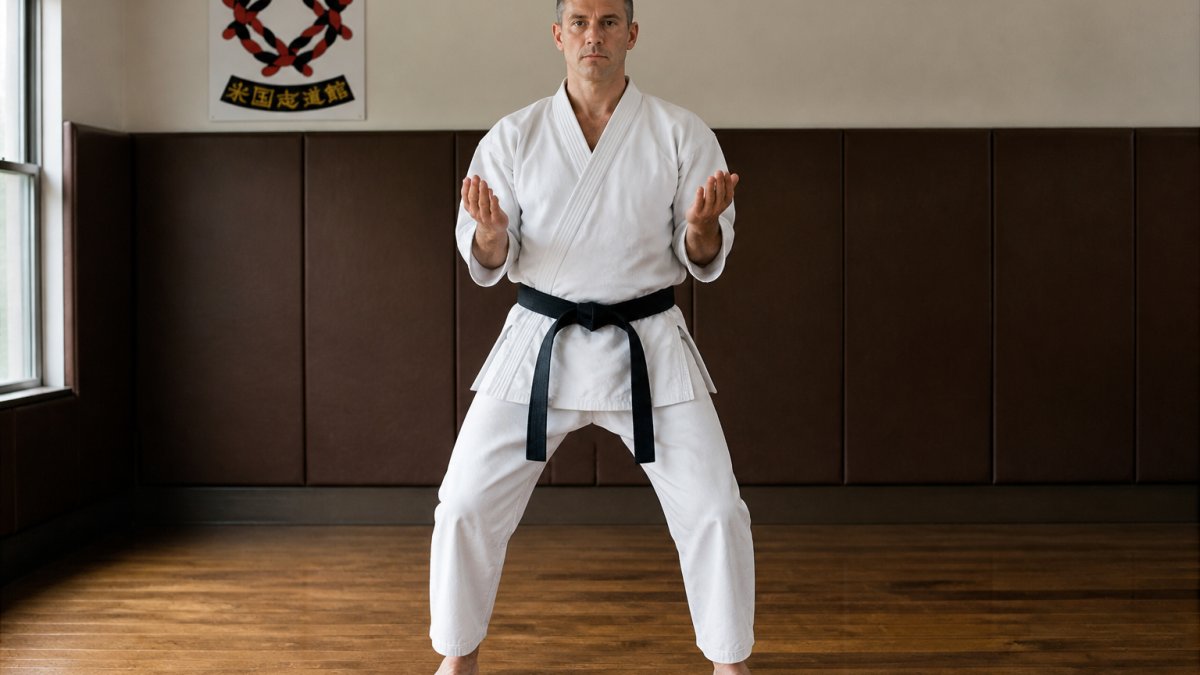
Your stance is your foundation, keeping you balanced and ready to move.
The basic defensive stance:
- Feet shoulder-width apart
- Knees slightly bent
- Weight on the balls of your feet
- Hands up at chest level with palms facing out
This position lets you move quickly, absorb impact, and protect your center. Practice until it feels natural.
Escaping Grabs and Holds
If someone grabs you, your goal is to escape and create distance.
Basic escape techniques:
- If grabbed from behind, drop your weight and step forward hard
- If someone grabs your wrist, rotate your arm toward their thumb (the weakest part of their grip)
- If grabbed around the torso, tuck your elbows and drive your hips forward
- Always move toward an exit or toward people who can help
The key to escaping any grab is immediate action.
How to Practice Self-Defense at Home
You don't need a dojo to start building skills.
What You Can Learn on Your Own vs. What Needs Supervision
Some skills transfer well to solo practice; others don't, and self-teaching them can build bad habits that fall apart under real pressure.
| Skill | Solo Practice | Needs Instructor Feedback |
|---|---|---|
| Situational awareness and threat recognition | Yes | No |
| Verbal de-escalation and boundary-setting language | Yes | Helpful |
| Stance, balance, and footwork | Yes, with a mirror | Yes for correction |
| Wrist and grab escapes | Limited, with a partner | Yes |
| Breakfalls and ground recovery | No | Yes |
| Striking mechanics and power generation | No | Yes |
| Scenario decision-making under pressure | Limited | Yes |
A Four-Week Starter Plan
This plan assumes 10-15 minutes a day, five days a week.
Week 1, Awareness and Baseline
- Each time you enter a room, note two exits and one object you could put between yourself and a threat.
- Practice a neutral, balanced stance in front of a mirror for 30 seconds, rest, repeat three times.
- Say three boundary-setting phrases out loud in a calm, firm tone: "I don't want any trouble," "Back up, please," "I'm leaving now."
Week 2, Distance and Movement
- Practice stepping back smoothly while keeping your hands up at chest level. Ten repetitions per session.
- Walk through a familiar space and rehearse a route to the nearest exit without rushing.
- Continue the awareness scan and the verbal phrases from Week 1.
Week 3, Escapes with a Partner
- With a trusted training partner, practice wrist escapes using slow, controlled resistance. Rotate your arm toward the weakest part of their grip (the thumb side).
- Practice breaking away from a light two-hand grab at the forearm by dropping your weight and stepping back hard.
- Keep all resistance light. The goal is clean mechanics, not speed.
Week 4, Scenario Rehearsal
- Have your partner describe a short scenario (someone approaching too close, someone blocking your path) and practice your verbal response and your exit.
- Run each scenario three times, then switch roles.
- Review what felt slow or unclear and repeat those pieces.
Safety Rules for Home Practice
- Keep resistance light. If either partner feels pain in a joint, stop immediately.
- Clear the floor of furniture and sharp edges before any movement drill.
- Skip breakfall practice at home unless you've been taught how to fall safely by an instructor.
Scenario-Based Practice and Stress Inoculation
Real attacks are chaotic, and the mental load of a real threat differs from a calm drill. Build tolerance at home with mild, safe stressors:
Start Now Before Someone Nabs Your Spot in Class! →
- Have your partner talk over you or stand closer than is comfortable while you deliver your verbal boundary.
- Practice your exit while counting backward from 20, to simulate divided attention.
- Run the same scenario from a seated position, or with one hand occupied, so you aren't only rehearsing the easy version.
Keep these drills short and controlled. The goal is decision-making under mild pressure, not overwhelm.
How Long Does It Take to Learn Self-Defense
The timeline to learn practical self-defense depends on your goals, how often you train, and whether you practice solo or with an instructor. Basic awareness and escape techniques take weeks; real confidence and automaticity take months.
Realistic Milestones by Skill
| Timeframe | What You Can Achieve |
|---|---|
| 2-4 weeks | Basic stance, awareness habits, simple verbal de-escalation, wrist escape mechanics |
| 1-3 months | Confidence in low-threat situations, smoother escapes, automatic awareness scans |
| 3-6 months | Reliable responses to common grabs, better distance management, calmer under mild pressure |
| 6-12 months | Solid foundation for most real-world scenarios, faster recovery from surprise |
These ranges assume consistent practice.
A Week-by-Week Path for the First Month
Weeks 1-2, Awareness and Stance
- Build the habit of scanning every room you enter for exits and obstacles.
- Practice the defensive stance until it feels balanced and natural.
- Start saying boundary-setting phrases out loud so the words feel familiar.
Weeks 3-4, Distance and Simple Escapes
- Practice stepping back smoothly while keeping your hands up.
- Learn one or two wrist escapes with a partner at slow speed.
- Begin short scenario rehearsals: someone approaches too close, you set a boundary, you leave.
Months 2-3, Repetition and Pressure
- Add controlled resistance to your escape drills.
- Practice the same techniques from different starting positions (seated, cornered, carrying something).
- Start noticing which movements still feel slow and repeat those specifically.
Months 4-6, Automaticity
- Your body should start responding before you consciously think through each step.
- Add mild stressors to scenario practice so you can rehearse decision-making under pressure.
- This is when most people move from "learning self-defense" to "having self-defense skills."
What Changes the Timeline
- Frequency: Two to three sessions a week beats one long session, even at the same total hours.
- Feedback: Practicing with an instructor who corrects your form shortens the learning curve significantly compared to solo repetition of a flawed movement.
- Starting point: Prior experience with any movement discipline helps, but it isn't required.
- Consistency: Gaps of weeks between sessions reset much of the progress.
What You Can Learn Remotely vs. In Person
Online instruction can teach the concepts behind awareness, de-escalation, and escape techniques, and it's useful for previewing a style or reinforcing in-person learning.
Choosing a Self-Defense Class for Beginners
Training with an instructor accelerates learning. A good class provides structure, feedback, and community.
Evaluating Instructors and Class Safety
When choosing an instructor, look for these qualities:
- Real experience: An instructor should have trained for years, not months
- Teaching ability: Can they explain concepts clearly? Do they adjust for different fitness levels?
- Safety focus: Do they emphasize control and technique over intensity?
- Student diversity: Are there people of different ages and fitness levels in class?
Ask about the instructor's background and training philosophy; a good instructor answers directly.
At Virginia Dojo, our classes are taught by a 9th-degree karate master with over 50 years of experience. We offer Adult Self Defense Karate and Women's Self Defense classes designed to meet you where you are, whether you're starting from scratch or building on prior experience.
What to Expect in a Beginner Class
A good beginner self-defense class follows this structure:
- Warm-up: Light movement to prepare your body (5-10 minutes)
- Awareness training: Scenario discussion and threat recognition (10-15 minutes)
- Technique instruction: Learning specific movements with instructor feedback (20-30 minutes)
- Controlled practice: Practicing techniques at your own pace (10-15 minutes)
- Cool-down and review: Stretching and discussing what you learned (5-10 minutes)
You should never feel rushed or pressured. A quality class moves at a pace that lets everyone participate. You should leave feeling stronger and more confident, not exhausted or intimidated.
Legal and Ethical Limits of Self-Defense
Understanding the legal side of self-defense is crucial: using force to protect yourself is legal, but with limits.
Self-defense is legally justified when:
- You face an immediate threat of harm
- You use only the amount of force needed to escape or stop the threat (Justice Manual | 1-16.000 - Department of Justice Policy On Use Of Force)
- You had no reasonable way to avoid the situation
Self-defense becomes illegal when:
- You use excessive force beyond what was necessary
- You continue fighting after the threat has ended
- You use force against someone who is no longer a threat
The goal of practical self-defense is always escape, not retaliation. Once you're safe, the threat is over. Continuing to fight is no longer self-defense, it becomes assault.
Different states have different laws, but this principle holds everywhere: use only the force you need to get to safety, then leave.
Learning practical self-defense gives you tools to stay safe and a sense of control over your personal security. At Virginia Dojo, we help adults and mature teens develop these skills in a supportive environment, focusing on natural movement and real-world scenarios.
Frequently Asked Questions
Can you learn practical self-defense at any age, even if you haven't trained before?
Yes. Practical self-defense focuses on natural movement, leverage, and awareness rather than strength or athleticism. Adults of all fitness levels can learn effective techniques through consistent practice. Many beginners see improvement in confidence and basic skills within the first few weeks of training, though deeper proficiency takes longer. A qualified instructor will scale techniques to your current ability.
How long does it take to learn self-defense well enough to use it in a real emergency?
Basic defensive awareness and escape techniques can be learned in weeks, but practical competence, the ability to react under stress, typically requires 3 to 6 months of regular practice. Situational awareness and de-escalation skills develop faster than physical techniques. Consistent training, scenario-based practice, and stress inoculation accelerate learning. The key is repetition and real-world scenario training, not just memorizing moves.
What should I look for in a self-defense class for beginners?
Choose an instructor with proven experience and a teaching approach focused on practical, real-world scenarios. Verify that the class environment is supportive and non-competitive, with clear communication about what training involves. Ask about class size, instructor qualifications, and whether techniques are explained before practice. A good beginner class emphasizes fundamentals, allows questions, and adapts to different fitness levels and ages.
Is it better to learn self-defense at home or in a class?
In-person instruction is more effective for beginners because an instructor can correct your form, provide feedback under pressure, and help you practice realistic scenarios safely. Online resources and home practice are useful supplements, drilling techniques, building muscle memory, and reviewing concepts, but they cannot replace hands-on guidance. Combining both approaches (class instruction plus home practice) accelerates learning and builds confidence faster than either alone.