 Ultimate guide
Why Choose Traditional Okinawan Karate: A Complete Guide
Last Updated: October 28, 2026
Quick Summary
Choose traditional Okinawan karate because it is a practical self-defense system shaped by history and culture rather than by rules for scoring points. It emphasizes natural movement, conditioning built into technique, and slow, mastery-focused progression for real situations.
- Okinawan karate was practiced for over a century before spreading to Japan in 1922.
- Okinawan styles emphasize self-defense and conditioning, while Japanese systems trended toward standardized instruction and sport formats.
- A first adult class runs about 60 minutes, from warm-up through cool-down and questions.
- Weeks one through four often feel clumsy, and that is the normal curve for adult beginners.
- Classes are taught by a 9th-degree master with over 50 years of experience, with no contracts.
Table of Contents
- What Makes Traditional Okinawan Karate Different
- Okinawan Shorin Ryu Karate and the Shi-Do Kan Lineage
- Traditional Okinawan Karate Benefits for Adults and Older Beginners
- Okinawan Karate Self-Defense That Works in Real Situations
- How to Evaluate an Instructor, Lineage, and Dojo
- What a Beginner Class Actually Involves
- Finding an Alexandria VA Karate Dojo That Fits Your Goals
- Start Your First Adult Self-Defense Karate Class
- Frequently Asked Questions
What Makes Traditional Okinawan Karate Different
Traditional Okinawan karate is a self-defense system developed on Okinawa and shaped by history, necessity, and culture rather than by rules for scoring points. That distinction matters more than most people realize. At Virginia Dojo in Alexandria, Virginia, we teach Okinawan Shorin Ryu because the art was built for real situations, not for judges. Karate was practiced in Okinawa for over a century before its spread into Japan began in 1922, according to research on karate's globalization. Below, we'll show you exactly how that origin story changes what you learn in class.
Okinawan Origins and the Move Beyond the Island
Okinawa, once part of the Ryūkyū Kingdom, produced a martial art rooted in practical protection. A chapter on traditional martial arts from the Living Heritage Series describes karate as a traditional martial art developed on Okinawa, and a 2026 feature in Best Version Media characterizes Okinawan karate as a practical system of self-defense and personal protection shaped by history and culture. The art left the island slowly, first reaching mainland Japan in the 1920s and later moving toward Western countries.
Okinawan Karate vs. Japanese Karate: A Balanced Look
Okinawan styles often emphasize self-defense and conditioning, while Japanese systems trended toward standardized instruction and sport formats. That's a generalization, not a law. Online discussions of the split note plenty of variation between schools, so judge any dojo by its actual curriculum rather than its label.
Feature | Okinawan Karate | Japanese Karate |
|---|---|---|
Primary aim | Personal protection | Standardized forms and sport |
Stance work | Natural, upright | Deeper, wider |
Conditioning | Built into technique | Often separate |
Progression | Slow, mastery-focused | Often faster belt pacing |
Okinawan Shorin Ryu Karate and the Shi-Do Kan Lineage
Our dojo's Shorin Ryu roots are documented in the Shidokan Shorin Ryu Karate lineage. We trace our lineage back to Sokon Matsumura, body guard to the last 3 Okinawan kings and key figure in almost every karate style.
Traditional Okinawan Karate Benefits for Adults and Older Beginners
Our program is built for adults and mature teens. For a closer look at what Shorin Ryu training offers older beginners, read about the benefits of Shorin Ryu Karate for adults.
Balance, Flexibility, and Natural Body Movement
If balance is your main goal, our article on karate for balance and flexibility in adults goes deeper.
Mental Discipline, Focus, and Confidence
One Alexandria student put it plainly: "The program has completely changed how I approach personal safety and fitness."
Okinawan Karate Self-Defense That Works in Real Situations
As student Amanda from Alexandria said, "I owe you my life! If I had never set foot in your self-defense karate class... I would be dead!" Another student noted that learning the grappling responses "reveals a new meaning to Self Defense Karate." If you want a structured path, read our step-by-step guide to learning practical self-defense.
How to Evaluate an Instructor, Lineage, and Dojo
Judge a dojo on four things: the instructor's teaching experience, the documented lineage, the class structure, and whether the environment fits you. A 9th-degree ranking means little without decades of instruction behind it, which is why we point prospective students to our karate instructors' backgrounds. Ask what a typical session includes.
Start Now Before Someone Nabs Your Spot in Class! →
What a Beginner Class Actually Involves
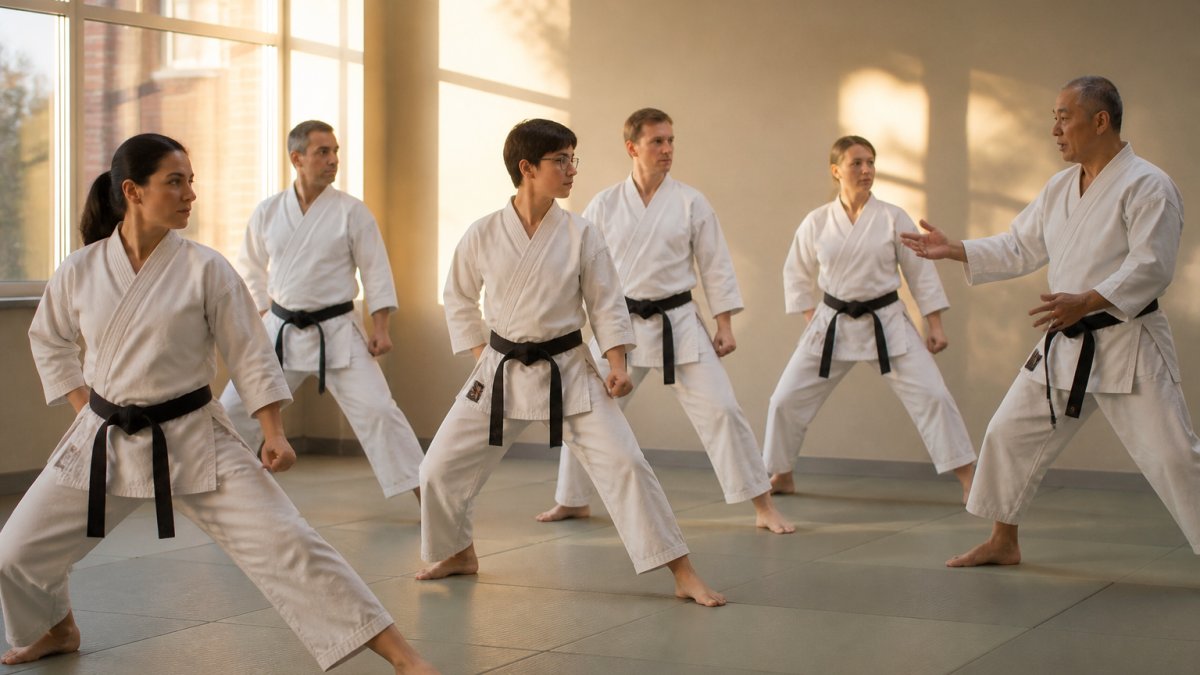
Most dojo websites tell you a beginner class is "welcoming" and "for all levels" and leave it there. That's not useful when you're trying to decide whether to walk through the door. Here's what actually happens in a first adult class at Virginia Dojo in Alexandria, minute by minute, plus what the first three months look like.
A Sample First Class (About 60 Minutes)
- 0-10 minutes: Warm-up. Joint rotations, light movement, and a few minutes of walking through the space to get your body temperature up. No running laps, no push-up tests.
- 10-25 minutes: Kihon Kata, stance and movement basics. You'll learn the natural upright stance, how to step, how to turn, and how to shift weight without bracing. This is the foundation everything else sits on, and it's taught slowly.
- 25-40 minutes: A simple self-defense drill. One or two responses to a common grab or approach, practiced with a partner at a pace you control. No contact you haven't agreed to, and no free-form exchange.
- 40-50 minutes: A basic form segment. The first few movements of the introductory form, repeated in short bursts with correction from the instructor.
- 50-60 minutes: Cool-down and questions. Light stretching, then time to ask the instructor anything you didn't want to ask mid-class.
What the First Three Months Look Like
A common pattern for adult beginners is that weeks one through four feel clumsy, you're learning to move in ways your body hasn't asked for in decades. Weeks five through eight, the stance work starts to feel automatic and you notice you're standing differently at the grocery store. Weeks nine through twelve, the first form starts to make sense as a sequence rather than a list, and the self-defense drills begin to connect to the stance work. Nobody is good at this in month one. Everyone feels uncoordinated for a few weeks. That's the normal curve, not a sign you're behind. Developing this foundational patience mirrors the broader benefits of martial arts where the focus remains on personal growth rather than immediate mastery.
What You Won't Be Asked to Do
- No contact drills you haven't agreed to in advance.
- No contract.
- You'll receive a free karate uniform when you sign up for the introductory month classes.
- No pressure to keep up with anyone else in the room. The instructor corrects posture, not speed.
Wear loose athletic clothing and bring water to your first class. You don't need special equipment, and you don't need to be flexible before you start, flexibility is one of the things the training builds, not a prerequisite for walking in.
How Instructors Adapt for Different Bodies
Older beginners, people recovering from old injuries, and people who haven't exercised in years all train in the same room, and the instructor adjusts the depth of a stance, the height of a kick, and the pace of a drill to match. If something doesn't feel right, you say so and the movement gets modified. That's not a special accommodation, it's how traditional Okinawan training has always worked, because the art was built for real bodies in real situations, not for a standardized test.
Finding an Alexandria VA Karate Dojo That Fits Your Goals
Choosing an Alexandria VA karate dojo comes down to fit: schedule, teaching style, and whether the room feels welcoming. We run adult-focused classes, including a mid-day option for retirees and flexible schedules, and our students have left more than 100 five-star Google reviews. If you're searching for a karate dojo near me in Northern Virginia, visit us.
Start Your First Adult Self-Defense Karate Class
Our classes are taught by a 9th-degree master with over 50 years of experience, focus on natural movement rather than strength, and carry no contracts. You'll get a free uniform when signing up and a mature training environment built for adults and teens. Get started with Virginia Dojo.
Frequently Asked Questions
What are the benefits of traditional Okinawan karate for adults?
Adults who train in traditional Okinawan karate work on balance, flexibility, and physical fitness. The art emphasizes natural body movement rather than brute strength, and the program is designed for adults and mature teens.
Is traditional Okinawan karate suitable for adult beginners?
Yes. Virginia Dojo offers training for adults and mature teens, with a focus on natural movement rather than strength.
How does Shorin Ryu karate support practical self-defense?
Virginia Dojo's Okinawan Shorin Ryu Shi-Do Kan Karate training focuses on natural movement and real-world self-defense. The program includes grappling and tussling responses.
Can Okinawan karate improve balance and flexibility?
Virginia Dojo's program focuses on natural movement and offers adults an opportunity to improve balance and flexibility.
What should adults look for in an Okinawan karate dojo?
Start with the instructor: ask about their rank and teaching experience. Look for a mature training environment and clear information about contracts. Virginia Dojo has more than 100 five-star Google reviews.
How can I find traditional Okinawan karate training in Alexandria, Virginia?
Look for a local martial arts school that names its Okinawan lineage, such as Shorin Ryu, and states the instructor's credentials plainly. In Alexandria, Virginia Dojo trains adults and teens in Okinawan Shorin Ryu Shi-Do Kan karate under a 9th-degree master with over 50 years of experience, with no contracts and a free uniform for new students.