 How-to
7 Injury Prevention Rules for Adult Martial Arts
Last Updated: October 30, 2026
Quick Summary
Martial arts injury prevention means building safe habits from your first class: warm up for at least 10 minutes, learn technique slowly before adding speed, tap out early, and tell your instructor about old injuries so drills can be adapted. Choose a program with small classes and close form supervision.
- Warm up for at least 10 minutes before every class because cold joints tear.
- Agree on speed, force, and target with your partner before each drill.
- Return after injury in four stages: mobility, stability, controlled partner work, then full class.
- Stop training and get checked for sharp pain, growing swelling, or a joint that gives way.
- Ask about contact level, class ratios, and contract terms before you enroll.
Table of Contents
- Why Adult Beginners Get Hurt and How to Avoid It
- Martial Arts Injury Prevention Starts With Your First Class
- Beginner Martial Arts Safety: The Habits That Protect You
- Martial Arts Warm-Up Exercises for Adults Over 50
- Partner Drills and Controlled Resistance Without the Risk
- Returning to Martial Arts After an Injury
- Common Injuries, Warning Signs, and When to Stop
- Book a Trial Class at Virginia Dojo in Alexandria
- Frequently Asked Questions
Why Adult Beginners Get Hurt and How to Avoid It
A 2026 study reported 127 injuries among 75 athletes, an injury rate of 1.4 injuries per 1,000 hours of exposure (injury rates and patterns in martial arts study(https://pmc.ncbi.nlm.nih.gov/articles/PMC12898159/)). That is a real number, but it comes from one group of athletes in one setting. It is not a universal rate for every adult class.
Here is the part most guides skip: avoiding injury in adult martial arts is less about toughness and more about how you start. Adults over 50 who train with control, good coaching, and a smart warm-up get hurt far less than those who rush.
At Virginia Dojo, we teach Okinawan Shorin Ryu Karate to adults and mature teens in Alexandria, Virginia. Our program uses natural movement instead of brute strength. Below, we break down rules that keep beginners safe.
Martial Arts Injury Prevention Starts With Your First Class
Martial arts injury prevention is the set of habits and program choices that lower your risk of strain, sprains, and joint damage before they happen. The first class sets the pattern for everything after it.
Joint sprains are among the most common martial arts injuries. So the training format matters more than people think.
Questions to Ask Before You Enroll
Ask these before you sign anything:
- Is there a required contact level, or can I train without it?
- How many students per instructor are in a beginner class?
- What is the warm-up routine, and how long does it last?
A good school answers all five without flinching.
What a Safety-Conscious Program Looks Like
Look for small class sizes, a clear warm-up and cool-down, and instructors who watch form closely. The EXTERNAL_LINK: AAOS guidance on martial arts safety | orthoinfo.aaos.org stresses supervision, proper protective equipment, and thorough training. A program that skips these is a program that will hurt you.
Beginner Martial Arts Safety: The Habits That Protect You
Beginner martial arts safety comes down to a few daily habits. Build them early and they carry you for years.
- Warm up for at least 10 minutes. Cold joints tear.
- Learn the technique slowly first. Speed comes later.
- Tap out early. Signal the moment something feels wrong.
- Hydrate and rest between rounds.
- Tell your instructor about old injuries. They can adapt drills.
- Skip the ego lifting. Strength builds over months, not days.
A common mistake is pushing through sharp pain to keep up with the group. That is how beginners end up sidelined for weeks.
Here are the daily habits that keep adult beginners safe on the mat.
Habit | What to do |
|---|---|
Warm-up | Warm up for at least 10 minutes |
Technique | Learn the technique slowly first; speed comes later |
Tapping | Tap out early when something feels wrong |
Hydration and rest | Hydrate and rest between rounds |
Old injuries | Tell your instructor about old injuries so drills adapt |
Ego lifting | Skip it; strength builds over months, not days |
Martial Arts Warm-Up Exercises for Adults Over 50
Warm-up exercises for adults over 50 should raise your heart rate, loosen your joints, and wake up your balance system. Ten to fifteen minutes is enough.
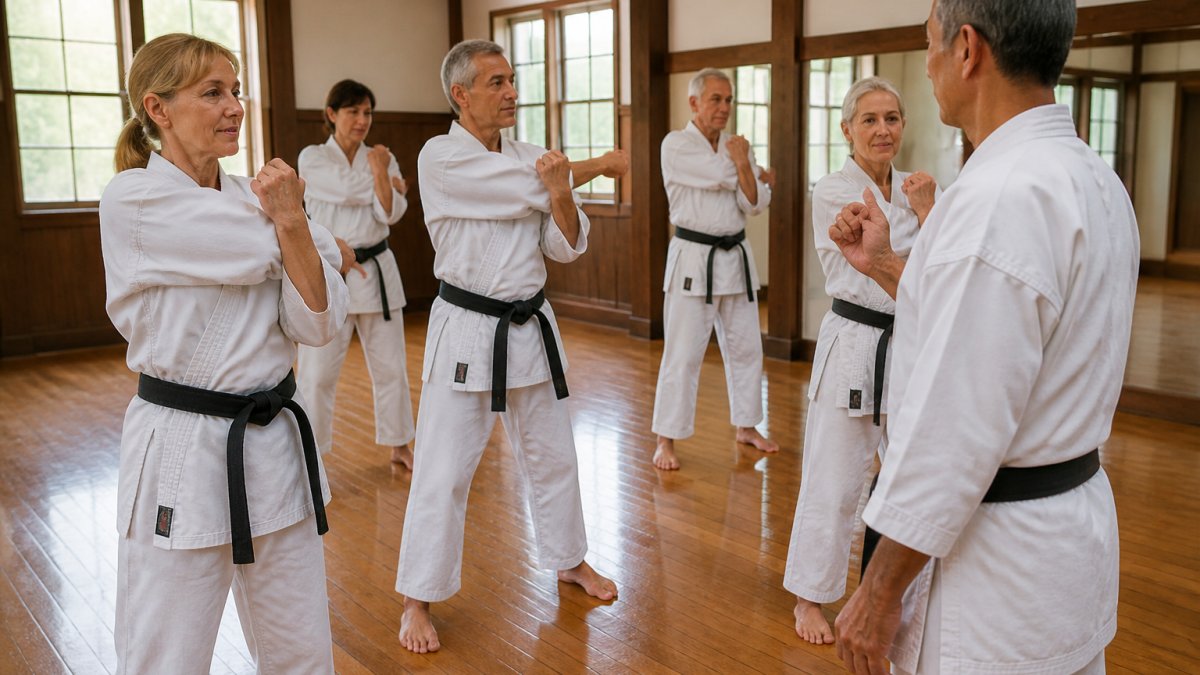
Try this sequence before every class:
- Neck rolls and shoulder circles to loosen the upper body
- Hip rotations and leg swings to prep the hips and knees
- Ankle circles to steady your base
If you are over 50 and comparing styles, our guide to the best martial arts for seniors covers which ones suit older bodies best.
Cool-Down and Recovery After Class
Spend five to ten minutes cooling down. Slow stretches, deep breathing, and a short walk help your heart rate settle. Drink water and get sleep. Recovery is when your body actually adapts.
Want more detail on how karate builds balance and flexibility safely? Read our guide to karate for balance and flexibility in adults.
Partner Drills and Controlled Resistance Without the Risk
Partner drills teach timing, distance, and body mechanics without the danger of full contact. The instructor sets the intensity, and you work at a controlled pace. Friction from these repetitive movements often compromises skin integrity, making the process of treating mat burns an essential skill for maintaining consistent training hygiene.
The 2024 nationwide analysis found that males had upper-extremity martial arts injuries at 2.4 times the rate of females (EXTERNAL_LINK: nationwide analysis of upper extremity injuries | pubmed.ncbi.nlm.nih.gov) (A nationwide analysis of upper extremity injuries in martial arts). That gap shows how much force control matters. Controlled resistance, not raw power, is what keeps drills safe.
What "Controlled Resistance" Actually Means
Controlled resistance is a dial, not a switch. Before each drill, agree with your partner on three things:
- Speed, start at half speed. If either of you cannot perform the technique cleanly, drop lower.
- Force, apply enough resistance to make your partner adjust, not enough to stop them cold.
- Target, agree on where contact is allowed (for example, forearms and shoulders) and where it is not (head, neck, joints).
A simple rule: if you cannot hold a conversation during the drill, you are working too hard for a beginner session.
Protective Equipment That Matters
Most adult beginner classes need less gear than people expect, but a few items earn their place:
Start Now Before Someone Nabs Your Spot in Class! →
- Mouthguard, protects teeth and jaw from accidental elbows and knees during close-range work.
- Hand wraps or padded gloves, reduce knuckle and wrist strain during striking drills on pads.
- Knee sleeves, useful for adults with past knee issues during stance and footwork work.
Ask your instructor what the school requires versus what is optional. A safety-conscious program will have a written list.
Communication Rules Before You Begin
Set these before the first repetition, every time:
- Agree on a tap signal, two taps on the partner or the mat means stop immediately.
- Name a verbal stop word, "stop" or "break" should end the drill instantly, no questions asked.
- Keep your eyes on your partner, looking away is how accidental contact happens.
- Speak up early, say "lighter" or "slower" the moment something feels off, not after.
- Reset between rounds, step back, breathe, and re-agree on intensity before continuing.
How to Scale Intensity Safely
Progression in partner work should follow a predictable ladder:
- Week 1-2: static drills with no resistance, learn the shape of the technique.
- Week 3-4: slow-motion resistance, partner applies light pressure so you feel the mechanics.
- Week 5-6: half-speed with agreed targets, build timing and distance judgment.
Worried about contact? Our article on low-contact martial arts for adults shows what safer training options look like before you commit.
Returning to Martial Arts After an Injury
Returning to martial arts after an injury takes a graded plan, not a heroic comeback. The goal is to rebuild capacity in the same order you lost it: mobility first, then stability, then strength, then speed.
The Four-Stage Return Framework
Use this as a conversation guide with your instructor and, where appropriate, your clinician. It is not medical advice, it is a structure for pacing yourself.
Stage 1, Mobility and pain-free range (typically 1-2 weeks). Gentle joint circles, slow stretches, and bodyweight movements within a pain-free range. No partner work. The milestone is moving through your normal range without sharp pain.
Stage 2, Stability and light technique (typically 2-4 weeks). Slow solo forms, stance work, and light pad work at low intensity. The milestone is holding positions for 30-60 seconds without wobble or pain.
Stage 3, Controlled partner work (typically 2-4 weeks). Slow partner drills at half speed with agreed targets. The milestone is completing a full class at reduced intensity without next-day swelling or pain.
Stage 4, Full class with modified intensity. Add speed before force, and force before complexity. The milestone is two consecutive weeks of full classes with no flare-ups.
Working With Your Instructor and Your Clinician
Tell your instructor three things on your first day back:
- What the injury was and what movements your clinician flagged as risky.
- What your clinician said about timeline and load.
- What your personal warning signs are (for example, a specific twinge that precedes a flare-up).
A good instructor will adapt drills on the spot, swapping a pivot for a step, a jump for a lunge, or a partner drill for solo repetition. If your school cannot or will not modify drills, that is a signal about its safety culture.
Warning Signs You Came Back Too Fast
Stop and reassess if you notice:
- Swelling that appears hours after class and lasts into the next day.
- Pain that is sharper than it was the week before.
- A joint that feels unstable during normal movements.
A single flare-up is a signal to drop back one stage for a week, not to quit. A short step back is usually a better choice than a long one later.
Common Injuries, Warning Signs, and When to Stop
The most common injuries are joint sprains, muscle strains, and bruising. Most are mild. Some are not.
Stop training and get checked if you notice:
- Sharp pain that does not fade with rest
- Swelling that grows over hours
- A joint that feels unstable or gives way
Soreness after a workout is normal. Sharp pain during a drill is not. Trust that difference.
Book a Trial Class at Virginia Dojo in Alexandria
Ready to train safely? Check the Virginia Dojo Karate Martial Art Class Schedule to see class times and book a trial class. Our adult classes in Alexandria, Virginia are built for beginners, with no contracts. A 9th-degree master with over 50 years of experience leads our classes, and your first uniform is free.
Frequently Asked Questions
How can adults reduce the risk of injury when starting martial arts?
Start with a program that teaches technique before intensity. Warm up for at least ten minutes with joint mobility and light movement, tell your instructor about any prior injuries or physical limits, and progress at a pace your body accepts. Joint sprains are among the more common martial arts injuries.
What should older adults consider before beginning martial arts training?
Have a conversation with your doctor about balance, joint health, and any condition that affects exertion. Then look at the class itself: adult-only groups, an instructor with decades of experience, no requirement to take hits, and a warm-up that includes mobility work. A safety-conscious program provides supervision, protective equipment, and a proper warm-up and cool-down. Ask how the school handles all four before you enroll.
How can beginners tell whether a martial arts class is appropriate for their fitness level?
Take a trial class and watch how the instructor handles the slowest person in the room. A good adult program offers modifications for stiff hips, sore knees, and limited stamina, and lets you sit out a drill without comment. Ask about class size and whether beginners train alongside advanced students at the same intensity. If the answer involves keeping up or getting hit, that is your signal. Virginia Dojo runs adult and mature-teen classes, which suits beginners building balance and flexibility.
What signs mean an adult should stop training and seek medical advice?
Stop immediately for sharp joint pain, a pop or tear sensation, dizziness, chest pain, or numbness that does not fade within minutes. Soreness that lasts more than a few days, swelling that increases overnight, or pain that wakes you up also warrant a doctor's visit. Treat any joint that swells as a real signal rather than something to train through.
The biggest risk in adult martial arts is not the art itself. It is starting without guidance. Virginia Dojo gives you a calm, non-competitive space to build fitness, balance, and flexibility at your own pace. Get started with Virginia Dojo and train with confidence, not fear.