 How-to
Karate for Balance and Flexibility in Adults
Last Updated: October 23, 2026
Quick Summary
Karate balance and flexibility training gives adults a structured way to build both, and early research is encouraging: a five-week program for improved balance and strength in older adults. Karate is a repeated balance challenge, since every stance change and turn asks your body to stay upright. Expect gradual change over weeks, not days.
- Table of Contents
- Why Karate Is a Smart Choice for Adult Balance and Flexibility
- Karate Balance Exercises for Adults
- Karate for Flexibility: What to Expect and How to Improve
- Why Karate Is a Smart Choice for Adult Balance and Flexibility
- Karate Balance for Adults
- Beginner Karate for Adults: Adapting to Your Age and Fitness Level
- Karate Develops Balance, Coordination, and Body Awareness
- Safety, Injury Prevention, and Recovery for Adult Beginners
- Choosing Adult Karate Classes in Alexandria, VA
- Conclusion
- Frequently Asked Questions
- Beginner Karate for Adults: Adapting to Your Age and Fitness Level
- How Karate Develops Balance, Coordination, and Body Awareness
- Safety, Injury Prevention, and Recovery for Adult Beginners
- Choosing Adult Karate Classes in Alexandria, VA
- Conclusion
- Frequently Asked Questions
Why Karate Is a Smart Choice for Adult Balance and Flexibility
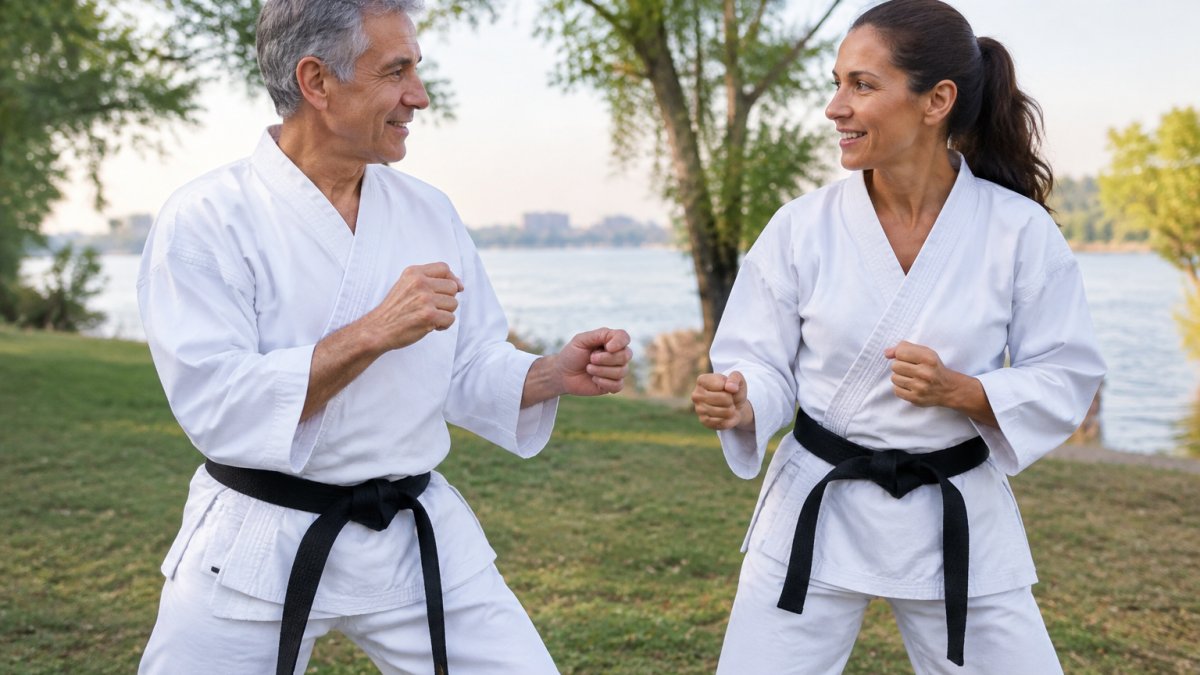
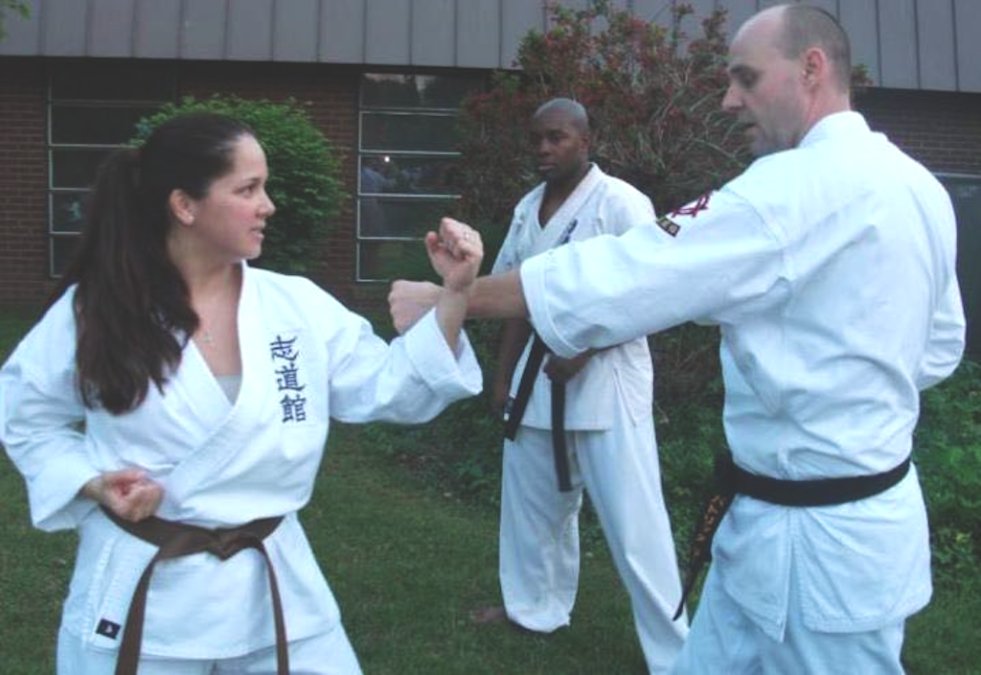
Karate training gives adults a structured way to build karate balance and flexibility. At Virginia Dojo, we teach Okinawan Shorin Ryu Shi-Do Kan karate to adults in Alexandria, Virginia, and we hear the same question from nearly every new senior student: will this actually help my body at my age? The answer is yes!
What the Research Actually Shows
The most-cited study here is small and preliminary, and we will not oversell it. In that five-week program, participants completed an average of 2,437 steps, 1,762 turns, 3,585 stance changes, 2,047 punches, 2,757 blocks, and 1,253 strikes (Mustafa et al., 2022). Those are activity counts, not measured improvements.
What matters for you: karate is a repeated balance challenge. Every stance change and turn asks your body to stay upright. Do that often and the skill improves. In Okinawa, the birthplace of karate, it is normal to train in a Karate Dojo with members who are 60, 70, and even 80 years old being taught by a 90-year old Grand Master! These guys move dynamically with grace and flexibility. Something you can learn to do regardless of your age.
Karate Balance for Adults
Karate classes teach you proper stances and stepping to maintain your balance and prevent falls. Some changes provide dramatic improvement while others occur over time.
Karate for Flexibility: What to Expect and How to Improve
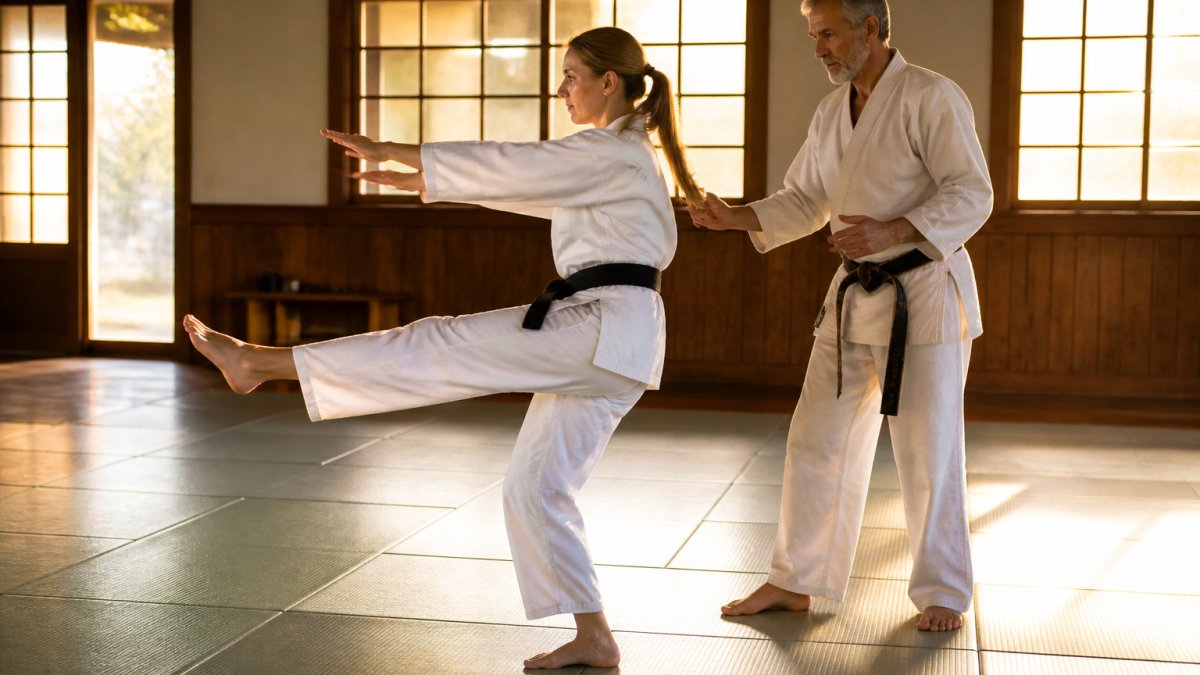
Karate balance flexibility is less about touching your toes and more about moving freely through stances. Hip mobility, ankle range, and shoulder openness matter most, because those are the joints that decide whether a stance feels stable or forced. Expect gradual change over weeks, not days.
Why Karate Stretches Different Joints Than a Gym Routine
A standard gym stretching routine tends to work muscles in isolation. Karate asks for range under load and while moving. A front stance demands hip flexion on one side and hip extension on the other at the same time. A turn asks your foot, ankles and hips to rotate while your torso stays upright. A slow front kick asks for hamstring length and hip control together.
What to Expect and How to Track It
Most adult beginners notice easier stance entry and less morning stiffness before they notice a measurable change in a toe-touch. Track three simple things once a week: how long you can hold a front stance with good posture, how high you can lift a slow front kick with control, and how a single-leg stand feels on each side. Write the numbers down.
Common Mistakes Adults Make
- Forcing depth in a low stance before the hips are ready. Depth comes from mobility, not willpower.
- Stretching cold. Warm up for five minutes before any stretch.
- Holding your breath during a hold. Breathe slowly and evenly.
- Skipping the cool-down because class ran long. Five minutes after class, when muscles are warm, is the most productive stretching window you have.
Beginner Karate for Adults: Adapting to Your Age and Fitness Level
Beginner karate for adults should match the body in front of it, not a template. If you are 58, or older, and haven't trained since high school, you are exactly who we build classes for.
- Start with knee-height kicks, not waist-height
- Use a wall or chair for balance drills early on
- Shorten holds before you shorten rest
- Tell your instructor about knees, hips, or back issues.
Karate Develops Balance, Coordination, and Body Awareness
Karate develops balance through repetition of positions. A stance is a controlled fall you catch with your muscles. Turns add proper foot placement and rotation. Blocks and strikes add reach, which shifts your center of gravity. Over time, your nervous system learns to correct faster.
Body awareness grows the same way. You learn where your weight sits, how your hips rotate, and how to recover when you wobble. That skill carries into stairs, icy sidewalks, and crowded rooms.
Start Now Before Someone Nabs Your Spot in Class! →
Safety, Injury Prevention, and Recovery for Adult Beginners
Safety comes first in any adult program. Warm up, progress slowly, and never train through sharp pain. The details below are what separate a program that respects an adult body from one that just scales down a template.
Warm-Up: The Five-Minute Minimum
A warm-up raises tissue temperature and primes the joints you are about to load (Dynamic Warm-ups Play Pivotal Role in Athletic Performance and Injury Prevention). For karate, that means ankles, hips, and shoulders.
Progression Rules That Prevent Most Beginner Injuries
- Increase training volume by one session at a time, not by adding intensity and duration together.
- Shorten holds before you shorten rest. Fatigue is where form breaks down.
- Add new drills one at a time so you can tell what caused a soreness or a setback.
- Keep kicks at knee height until you can lower the leg slowly and under control every time.
Red Flags: When to Stop and When to Seek Professional Guidance
Stop the session and rest if you feel sharp pain, joint pain that persists after class, dizziness, or a loss of balance you cannot correct. Ice and elevate minor strains. See a doctor or physical therapist for anything that lingers beyond a week, for pain that wakes you at night, or for any injury that changes how you walk. Tell your instructor about knees, hips, back, or shoulder issues before class, not after.
Recovery Between Sessions
Recovery is training. Sleep, hydration, and easy movement on rest days do more for your next class than an extra hard session does. A common pattern among adult beginners is to feel fine the day after class and sore two days later; if that happens, keep the next session shorter and lighter rather than skipping it entirely.
Adaptations for Older Adults and Adults Returning to Exercise
If you are in your fifties or sixties, or coming back after years away, the same drills work with three adjustments: use a wall or chair for balance work longer than you think you need to, keep holds shorter and repeat them more often, and prioritize control over depth in every stance. None of this is a lesser version of the training; it is the same training built around the body in front of the instructor.
Choosing Adult Karate Classes in Alexandria, VA
Choosing adult karate classes in Alexandria, VA comes down to fit, not flash.
Virginia Dojo is led by a 9th-degree master with over 50 years of self defense teaching experience. We focus on natural movement and real-world self-defense, with no contracts and no requirements for competitive fighting.
If you are searching for adult karate classes near me in Alexandria, visit us and watch a class before you decide.
Conclusion
Finding a routine that builds balance, flexibility, and confidence at the same time is harder than it sounds. Virginia Dojo offers Adult Self Defense Karate built around natural movement, a supportive non-competitive setting, and instruction from a 9th-degree master with over 50 years of experience. Start now and see what steady training can do for your balance and flexibility.
Frequently Asked Questions
Can karate really help adults improve balance and flexibility?
Yes. Karate training involves repeated stance changes, turns, and controlled movements that challenge your balance and mobility. A 2022 study of a five-week karate program found participants completed over 3,500 stance changes and 1,700 turns, and the program improved balance and strength in older adults. The research is preliminary, but the movement patterns themselves naturally build the skills you use to stay steady on your feet.
How often should adults practice karate to see flexibility gains?
Most beginners see gradual improvement with two to three sessions per week. Consistency matters more than duration. Give yourself eight to twelve weeks before expecting noticeable changes, and track small wins like reaching lower in a stance or turning more smoothly.
I'm in my 50s and new to martial arts. Will I be able to keep up in a beginner karate class?
Beginner karate for adults is designed for people exactly like you. Look for a program that emphasizes natural movement over brute strength and offers a non-competitive environment. Many adult students start in their 50s or 60s with no prior experience. A good instructor will offer modifications for stiffness or old injuries and let you progress at your own pace.
What should I look for in adult karate classes in Alexandria, VA?
Prioritize a program with experienced instruction, a supportive atmosphere, and a clear focus on practical movement. Ask about class size, whether there is a trial period, and how the instructor handles different fitness levels. Virginia Dojo in Alexandria offers adult classes taught by a 9th-degree master with over 50 years of martial arts teaching experience, in a non-competitive setting with no contracts.