 Listicle
7 Karate Classes for Mature Beginners in Alexandria
Last Updated: November 10, 2026
Quick Summary
The right karate classes for mature beginners offer adult-only instruction, a non-contact or light-contact training model, instructors who teach natural movement over power, and clear terms with no long-term contracts. Our Alexandria dojo teaches Okinawan Shorin Ryu to adults and mature teens, with no contracts and a free uniform to start.
- Ask how an instructor modifies a stance for a student with knee or hip limits before you enroll.
- Beginners should practice two to three times per week, with at least one rest day between sessions.
- The most common first-month mistake is doing too much too soon. Start at two sessions.
- Compare the total first-year commitment rather than the monthly rate alone when choosing a dojo.
- A five-minute daily routine of single-leg stands, heel-to-toe walks, and hip openers prepares you for class.
Table of Contents
- What Mature Beginners Should Look for in Karate Classes
- Karate for Seniors: Why Age Is Less of a Barrier Than You Think
- Virginia Dojo: Adult-Focused Instruction in Alexandria
- Beginner Karate Classes for Adults: What Your First Month Looks Like
- How Often Should Beginners Practice Karate?
- Karate Balance and Flexibility Exercises You Can Start Today
- Understanding the True Cost of Karate Classes in Alexandria
- Book Your First Karate Class in Alexandria
- Frequently Asked Questions
What Mature Beginners Should Look for in Karate Classes
The right karate classes for mature beginners share four traits: adult-only instruction, a non-contact or light-contact training model, instructors who teach natural movement over power, and clear terms with no long-term contracts.
Here is the uncomfortable truth most studio tours won't tell you: the class that looks most impressive on a brochure is often the worst fit for a 58-year-old with a stiff hip and a bad knee. Loud counts, fast drills, and a room full of teenagers tell you nothing about whether you'll still be training in six months.
Use this checklist when you evaluate any dojo:
- Is no or light contact optional, or is it built into every session?
- Does the instructor adjust stances for knees, hips, and shoulders?
- Are belt ranks tied to attendance pressure or to steady progress?
- Is the membership month-to-month, with the terms in writing?
- Can you watch or try a class before committing?
What most guides miss is that the checklist matters more than the style. A patient instructor teaching a modest curriculum beats a famous system taught impatiently every time. The CDC's physical activity guidance for older adults is a useful baseline for what a session should deliver: balance work, flexibility, and strength training, not just cardio.
Karate for Seniors: Why Age Is Less of a Barrier Than You Think
Age is less of a barrier than most people assume because karate rewards control, timing, and repetition rather than raw speed. A beginner at 60 and a beginner at 25 learn the same first stance. The difference is pacing, and good instruction adjusts pacing without watering down the technique.
We hear the same worry constantly: "I'm 58 and haven't done martial arts since high school. Will I keep up?" In practice, the adults who struggle most in the first month are usually the ones who push too hard, not the ones who start slow. Karate for seniors works when the instructor treats the first weeks as calibration, not a test.
What actually changes with age, and how a good dojo adapts
Most mature beginners are not limited by strength; they are limited by three specific systems that respond well to gradual loading:
- Balance. Standing balance depends on ankle, hip, and trunk coordination. Karate stances train all three at once, which is why single-leg work in class translates to steadier footing on stairs and uneven sidewalks.
- Joint range and recovery. Hips, knees, and shoulders lose range gradually, not suddenly.
- Reaction and processing speed. Timing drills done slowly build the same neural pathways as fast ones. Speed is added later, and only when the movement is clean.
A practical way to judge whether a dojo is mature-beginner-ready
Ask the instructor three questions before you enroll:
- "How do you modify a stance for a student with knee or hip limits?" A good answer is specific, shorter stance, less depth, supported transitions, not "we'll figure it out."
- "What does the first month look like for someone starting at 55 or 60?" You want to hear about calibration, not a fixed curriculum everyone follows at the same pace.
- "How do you handle a student who comes in with an old injury?" The answer should include a conversation about limits and a plan to work around them, not a waiver and a shrug.
For a deeper look at starting late, see our guide on starting martial arts at 55.
Watch out: a dojo that promises you'll "keep up with the young guys" in week one is telling you it has no mature-beginner plan. The right answer is about calibration, not catching up.
Virginia Dojo: Adult-Focused Instruction in Alexandria
Our Alexandria dojo teaches Okinawan Shorin Ryu Shi-Do Kan Karate to adults and mature teens in a calm, non-competitive room. Classes are led by a 75-year old 9th-degree master with more than 50 years of experience, and the curriculum emphasizes natural movement and practical self-defense over brute strength. No contracts. A free karate uniform comes with your start.
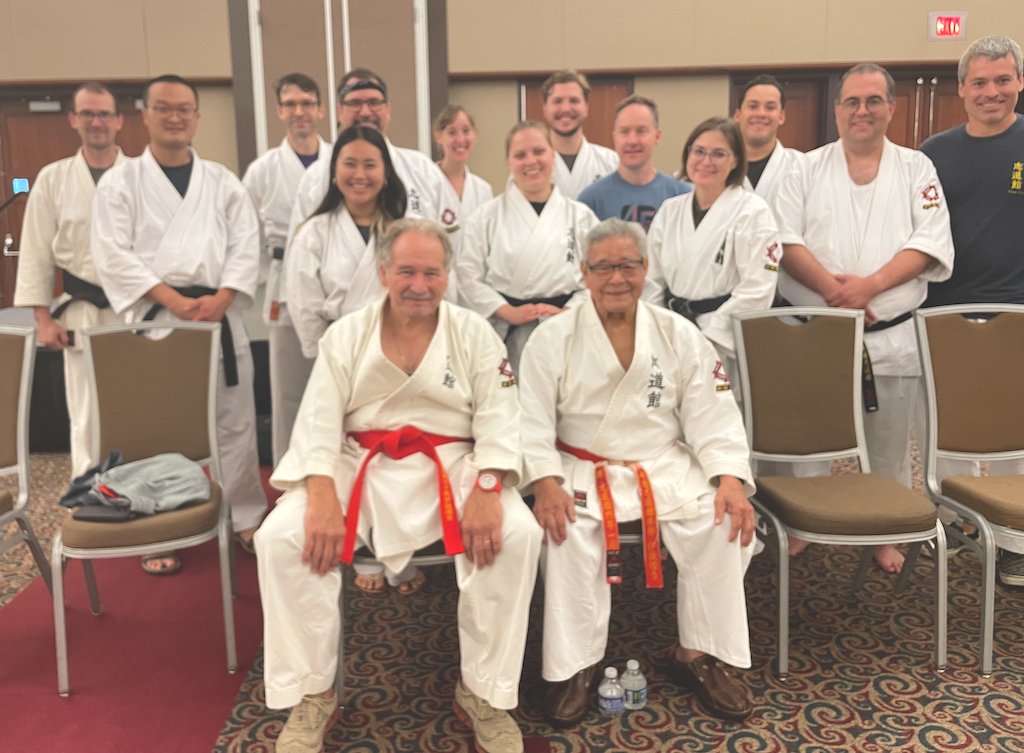
Virginia Dojo members with 75-year old 9th Degree sitting with his 90-year old 10th Degree instructor sitting in front.
Amanda, a customer in Alexandria, shared: "I owe you my life! If I had never set foot in your self-defense karate class... I would be dead!"
If you want to see how the senior-focused program is structured, you can explore our self-defense karate for seniors before you ever walk in the door.
Beginner Karate Classes for Adults: What Your First Month Looks Like
Your first month in beginner karate classes for adults focuses on learning how your body moves rather than on how hard you can move it.
Here is a realistic week-by-week picture:
Week | Focus | What You'll Notice |
|---|---|---|
1 | Stance, posture, breathing | Sore calves and shoulders better awareness of how you stand |
2 | Basic blocks and strikes in the air | Movements start linking together |
3 | Slow partner drills with control | Timing improves; less hesitation |
4 | Short sequences and simple forms | First real sense of flow |
Watch out: the most common first-month mistake is doing too much too soon. Adults who train five days in week one usually show up stiff and discouraged by week three. Start at two sessions and add a third once you recover comfortably.
How Often Should Beginners Practice Karate?
Beginners should practice karate two to three times per week, with at least one rest day between sessions. That frequency builds the repetition that technique depends on without overloading joints that are still adapting to new movement patterns. Daily practice is fine for short home sessions of ten to fifteen minutes; it is the intense dojo work that needs spacing.
Karate Balance and Flexibility Exercises You Can Start Today
Balance and flexibility exercises you can start today are simple: single-leg stands, slow heel-to-toe walking, gentle hip openers, and shoulder circles, done for a few minutes daily. These are the same patterns karate training develops, and starting them before your first class makes that first class far less intimidating.
Try this five-minute routine:
- Single-leg stand: 20 seconds per leg, holding a counter for safety
- Heel-to-toe walk: 10 steps forward, 10 back, along a wall
- Hip opener: slow knee circles, 8 per side, seated or standing
- Shoulder rolls: 10 forward, 10 back, breathing steadily
- Calf stretch: 30 seconds per leg against a wall
Do this daily for two weeks and you will notice the difference in how you enter a stance. For a fuller explanation of how martial arts training affects balance after 50, read our article on martial arts, balance, and flexibility after 50.
Understanding the True Cost of Karate Classes in Alexandria
The true cost of karate classes in Alexandria depends on the studio's membership model, not just the monthly rate. A low monthly fee attached to a twelve-month contract costs more than a slightly higher month-to-month rate you can leave anytime. Ask three questions before you sign anything: What is the total commitment? What happens if I stop? Are there testing or uniform fees?
What the total actually includes
When you compare dojos, build a single number that covers the first year, not just the first month. The line items that matter:
- Enrollment or registration fee. Often a one-time charge at sign-up. Ask whether it is refundable and whether it is waived for a trial.
- Monthly tuition. The headline number. Confirm whether it is month-to-month or tied to a contract term.
- Uniform and equipment. A gi and belt are usually required; some schools include the first uniform, others charge separately. Ask whether protective gear is required for your program. Ask if there are additional equipment or training fees.
- Testing or rank fees. Some schools charge per belt promotion. Ask how often testing happens and what each test costs. Ask if the cost of the belt is included in the testing fee. Some schools provide monthly testing for a fee and also charge for your new belt, too.
- Trial or introductory offer. A genuine trial lets you attend before committing. A "free" trial that requires a card and auto-enrolls you at the end is not a trial.
A simple comparison method
For each dojo you are considering, compare the total first-year commitment rather than the monthly rate alone, including any enrollment, uniform, equipment and testing fees.
Pricing depends on the program and schedule you choose, so when you visit the Virginia Dojo ask for current rates or to request a quote. (They are posted on the wall for all to see!) The Virginia Dojo does not require long-term contracts, and a free karate uniform is included. If contracts are your concern, our guide to karate classes without long-term contracts walks through what to check in any agreement.
Watch out: ask for any trial's cancellation terms in writing before you hand anything over.
Book Your First Karate Class in Alexandria
Booking your first class is the step that settles every question this article raised. You will know within one session whether the pace suits you, whether the instructor explains rather than barks, and whether the room feels like somewhere you'd return to. We invite you to start with a single class and decide from there.
When you're ready to pick a time, our class schedule shows the available adult sessions. Come in comfortable clothes, bring water, and leave the rest to us.
The hardest part of starting karate at 55 or 65 isn't the training. It's walking through the door the first time. Virginia Dojo exists to make that door easy to walk through: adult-only classes led by a 75-year old 9th-degree master with over 50 years of experience, natural movement instead of brute strength, no contracts, and no contact requirements. Get started with Virginia Dojo and find out what a supportive dojo feels like.
Frequently Asked Questions
Can you start karate as an adult?
Absolutely. Many karate classes for mature beginners are designed specifically for adults who have never trained before. Programs like those at Virginia Dojo focus on natural movement and practical self-defense rather than brute strength or prior athletic experience. Starting as an adult means you bring focus and discipline to your training, and instructors often adapt techniques to your current fitness level so you can progress safely. It is common in Okinawa to train in karate classes with 50, 60, and 70 year old practitioners in classes led by an 80 or 90-year old instructor.
Which karate style is best for older adults?
Styles that emphasize natural movement, balance, and controlled technique tend to suit older adults well. Okinawan Shorin Ryu, for example, focuses on practical self-defense and proper body mechanics rather than speed or force. When evaluating karate for seniors, look for a school that offers beginner-friendly instruction and a non-competitive environment where you can learn at your own pace.
How often should a beginner practice karate?
Most beginners benefit from attending class two to three times per week, with rest days in between to allow your body to recover. Consistency matters more than intensity when you are starting out. Many adult programs offer flexible schedules, so you can build a routine that fits your week. Practicing karate balance and flexibility exercises at home on off days can also help you progress between classes.
What should mature beginners look for in a karate class?
Look for beginner karate classes for adults that emphasize natural movement and offer modifications for different fitness levels. Ask about the instructor's experience, whether there are long-term contracts, and what a typical class includes. A supportive, non-competitive environment is especially important for mature beginners. Visiting a class can help you see if the teaching style and pace feel right for you.